Uriel Loredo

Market eyes Jackson Hole amid mixed inflation data.

The U.S. inflation report for July showed mixed signals. Headline CPI held steady at 2.7% year-over-year, while core inflation rose to 3.1%, up from 2.9% the previous month. This shift reinforces market focus on the upcoming Jackson Hole symposium and the Fed’s September decision. 

Other relevant highlights: 

  • Food: unchanged in July after a 0.3% increase in June. 
  • Energy: mixed performance – gasoline (-2.2%) and natural gas (-0.9%) fell, while heating fuel rose (+1.8%). 
  • Shelter: rose 0.2% MoM, unchanged from June. 

The Fed continues to monitor the impact of tariffs and their potential inflationary effects. Although two committee members supported immediate rate cuts, the overall tone remains cautious, with emphasis on balancing inflation and employment mandates. 
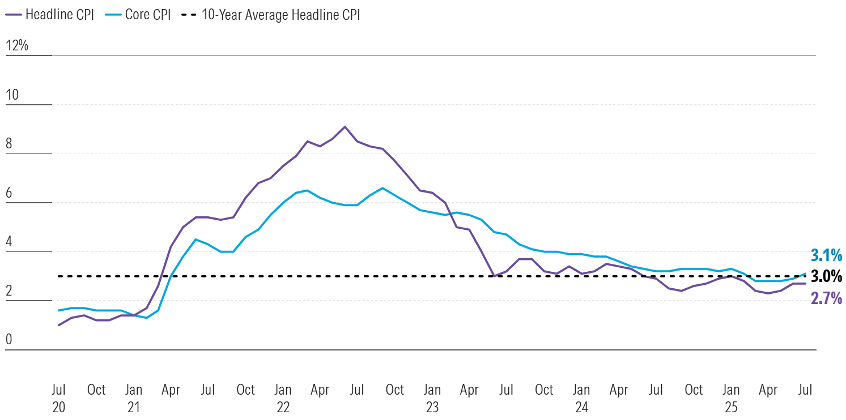
Source: Morningstar
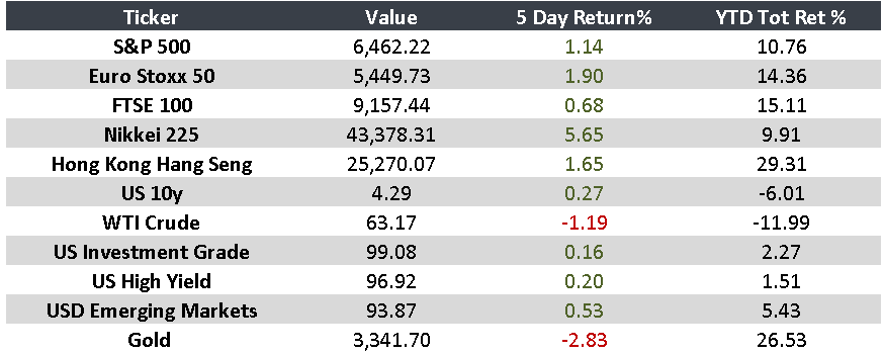
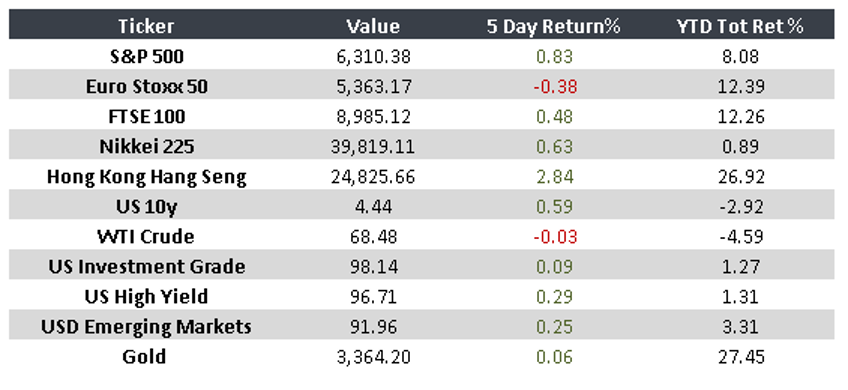
Trade tensions and mixed signals dominate the economic landscape 

This week, global markets reacted to a series of mixed developments. In the U.S., President Trump extended by 90 days the implementation of new tariffs on China, keeping the current 30% and 10% levels unchanged. July’s inflation came in slightly below expectations at 2.7%, driven by housing costs. 

In Europe, German investor confidence dropped sharply amid disappointment over EU-U.S. trade talks and weak economic performance. Analysts expect the ECB to hold rates steady at 2%, marking the end of its current easing cycle. 

In Asia, Japan’s producer inflation decelerated for a fourth month, while China posted soft data in retail sales and industrial production. In Latin America, Brazil announced a $5 billion support plan for local businesses, while Mexico highlighted a record trade deficit with China and a historic drop in poverty levels. 

“Never invest in any idea you can’t illustrate with a crayon.” — Peter Lynch 

KEY EVENTS NEXT WEEK 

  • U.S. Housing Starts and Building Permits → August 19 
  • FOMC Meeting Minutes → August 20 

Monitor

Between tariffs, rates, and inflation, August begins with divided signals in the markets. 

The month kicks off with trade tensions and monetary policy adjustments. 

The first week of August brings key monetary policy decisions, new tariffs, and mixed signals from major economies. Here’s a country-by-country recap: 

  • United States: The ISM services index stalled in July, showing higher inflation and weaker employment. President Trump announced new tariffs: an additional 25% on India for purchasing Russian oil, and 100% on semiconductor imports, with exemptions for companies investing in domestic manufacturing. 
  • Europe: The Bank of England cut its benchmark rate from 4.25% to 4%, though 4 of its 9 committee members voted to keep rates unchanged. The PMI showed a slight expansion in the business environment in July. 
  • China: The services sector grew at its fastest pace in 14 months, driven by domestic demand. Exports jumped 7.2% year-over-year in July, beating expectations. 
  • Brazil: The finance minister will meet with his U.S. counterpart as the country seeks alternatives to the recently imposed 50% U.S. tariff. 
  • Mexico: Banxico cut the policy rate by 25 bps to 7.75%, slowing the pace compared with previous 50 bps cuts. Annual inflation eased to 3.51% in July. The government unveiled Pemex’s 2025–2035 Strategic Plan to make the oil company more efficient and profitable. 

“The stock market is filled with individuals who know the price of everything, but the value of nothing.”
— Phillip Fisher 

KEY UPCOMING EVENTS 

  • U.S. inflation data release – 08/12 
  • Speeches by various Fed members – 08/13 

Monitor 

Why does August tend to be a challenging month for markets?

Investors often focus on corporate earnings reports, inflation, or central bank decisions, but there is another factor that also influences markets: seasonality. 

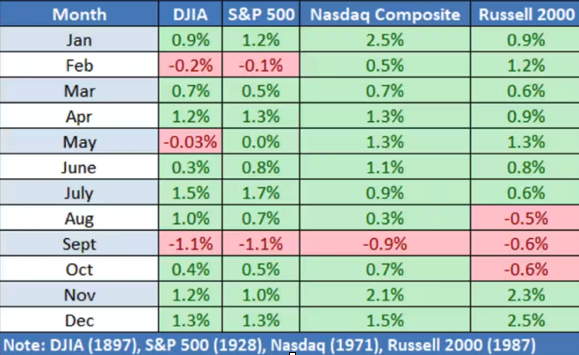
Historically, August has been one of the weakest months for financial performance. Since 1950, the S&P 500 has averaged near-zero or negative returns. In pre-election years or after a strong summer, the pattern often repeats. For the Nasdaq, August has been the second-worst month since 1971. 

  • Lower liquidity: With institutional traders away, market depth decreases. 
  • Few macro catalysts: August falls between key data and inflation periods. 
  • Psychological reset: Portfolios are reassessed after summer optimism. 

Market implications:

Volatility is not always negative, but it is rarely the result of chance. Therefore, in August as in any other period, patience and a long-term positioning matter more than very short-term performance. 

Solid growth in the U.S. and Mexico, while key tariff truces remain in place. 

Tariff truces, steady rates, and solid growth in the U.S. and Mexico 

Global markets start the week with mixed but constructive signals. Below is a brief country-by-country summary: 

  • United States: The Fed kept rates unchanged for the fourth consecutive time. Q2 GDP grew 3%, driven by consumer spending. An agreement was reached with the EU to cap tariffs at 15%, and the trade truce with China remains in place following new negotiations. Nonfarm payrolls came in below expectations, with 73,000 jobs created in June. 
  • Europe: Eurozone GDP grew 0.1%, with strong performance in Spain and France. Germany and Italy remain laggards. Inflation in Germany fell to 1.8%, below the ECB’s target. 
  • China: Industrial profits fell 4.3% in June, and manufacturing contracted for the fourth straight month. 
  • Brazil: In response to new U.S. tariffs, the government is preparing support measures for affected sectors. The central bank kept its benchmark rate at 15%, signaling the end of its tightening cycle. 
  • Mexico: Q2 GDP grew 0.7%, beating forecasts. The tariff pause with the U.S. was extended, keeping current rates in place. 

“It’s not whether you’re right or wrong that matters, but how much money you make when you’re right and how much you lose when you’re wrong.” — George Soros 

Important events in the next week 

  • In the United States, the ISM Services Index will be released on 08/05 
  • In China, inflation data will be published on 08/11 

Monitor 

Fed’s July Meeting: No Changes, but Signs of Slowdown

July Fed Monetary Policy Statement 

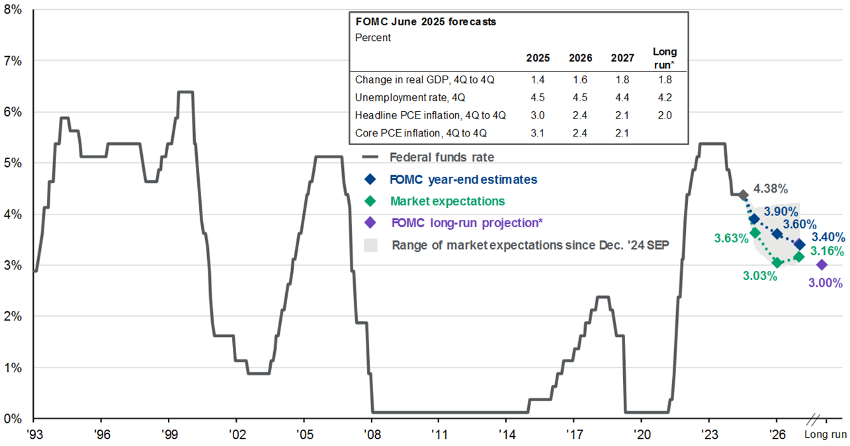
As markets anticipated, the Federal Reserve left its benchmark interest rate unchanged, maintaining the target range at 4.25%–4.50%. Unlike the more optimistic tone in June, this time the Fed acknowledged a slowdown in economic activity during the first half of the year. 

While the labor market remains strong and unemployment stays low, inflation is still somewhat elevated. As a result, the Committee reaffirmed its commitment to its dual mandate: maximum employment and price stability. 

A key highlight was the lack of unanimous support. Two members—Bowman and Waller—voted in favor of a 25-basis-point rate cut. This marks the first time since 1993 that multiple Fed governors have dissented on a rate decision. 

Market Implications: 

Focus now shifts to the annual Jackson Hole symposium in August, where the Fed Chair traditionally provides guidance on the direction of monetary policy. Markets are still pricing in a potential rate cut in September, which would lower the target range to 4.00%–4.25%. 

Federal Funds Rate Expectations

Source: JP Morgan

Trade and Mixed Data: Signs of Stability in the U.S. and China

Solid U.S. labor market, trade deals with Asia, and monetary pauses in Europe and China.

Global Outlook: Stability Amid Mixed Signals 
Recent data and key announcements from both developed and emerging markets reveal a landscape of resilience with a few areas of concern. Here are the most relevant highlights from the week: 

United States: 

  • Treasury Secretary Scott Bessent plans to extend trade negotiations with China and will meet with officials in Stockholm. A new trade agreement was reached with Japan, including 15% reciprocal tariffs and $550 billion USD in Japanese investments. Japan will open its market to U.S. agricultural and automotive products. 
  • Jobless claims fell to their lowest level in three months, reflecting a strong labor market. 

Europe: 

  • The European Central Bank held its benchmark rate at 2%, pausing after four consecutive cuts amid elevated uncertainty. 
  • Negotiations with the U.S. are progressing toward a potential trade deal with a general 15% tariff, expected to be finalized before August 1. 

China: 

  • The People’s Bank of China kept benchmark interest rates unchanged following slightly better-than-expected GDP data. 

Brazil: 

  • Despite ongoing trade tensions with the U.S., GDP is projected to remain strong, 2.2% in 2025 and 1.7% in 2026. However, if negotiations break down, inflation may rise, with projections of 5.2% for this year. 

Mexico: 

  • The government plans a new bond issuance to support Pemex liquidity, estimated at $7 to $10 billion USD. Inflation declined to 3.55% in the first half of July, down from 4.32% in June. 

“The stock market is a device for transferring money from the impatient to the patient.” —Warren Buffett 

KEY EVENTS TABLE 

  • U.S. Federal Reserve announcement – 07/30 
  • U.S. Employment data release – 08/01 

Monitor

Although President Trump has criticized the Fed, the legal basis for dismissal appears weak

Despite recent criticisms from former President Donald Trump toward the Federal Reserve (Fed), the possibility of an early removal of Fed Chair Jerome Powell seems limited. The Federal Reserve Act of 1913 does not grant the Executive Branch the authority to dismiss its officials due to disagreements over monetary policy. In addition, a recent Supreme Court decision further reinforced the central bank’s independence, making intervention even more difficult. Although the law allows for removal “for cause,” this clause has never been tested, leaving the legal grounds for dismissal uncertain.

Against this backdrop, three scenarios emerge regarding the Fed’s future under new leadership:

The Fed would maintain a technical approach, free from political pressure.

  • More predictable policy
  • Lower inflation
  • Greater long-term stability
  • In the short term: a flatter yield curve and wider credit spreads

A more flexible stance could lead to more expansive policies.

  • Boost to short-term growth and inflation
  • Result: steeper yield curve and higher inflation expectations

The Fed could succumb to pressure to keep rates low despite high inflation.

  • Loss of credibility
  • High volatility and potential abrupt adjustments, as in the Volcker era (1979)

However, early dismissal could trigger:

  • Temporary volatility spikes
  • Weaker U.S. dollar
  • Stock market declines
  • Distortion of the yield curve

Since the 1970s, the Fed has remained committed to controlling inflation as a core institutional priority.

Source: Capital Group

Inflation edges up, solid earnings reports, and signs of economic resilience


A key week for markets, marked by economic data, fiscal decisions, and mixed signals across the globe. 


Investors closely monitored inflation, consumption, and growth figures. Here are some of the most relevant developments: 

  • U.S.: June retail sales beat expectations, showing resilient consumer demand. However, annual inflation rose to 2.7% due to higher tariffs. Q2 2025 earnings season began on a positive note. 
  • Europe: UK inflation in June hit its highest level since January, reducing expectations of further rate cuts. In Germany, the government approved a fiscal stimulus package to support economic growth. 
  • China: June exports exceeded expectations amid a fragile tariff truce with the U.S. GDP grew at an annualized rate of 5.2% in Q2, reflecting continued economic resilience. 
  • Brazil: The government projects gross debt will rise from 71.7% of GDP at the start of Lula’s administration to 82.3% by 2026, pointing to mounting fiscal pressure. 
  • Mexico: The U.S. announced a 17% tariff on Mexican tomatoes. President Sheinbaum signaled interest in strengthening trade ties with Canada after speaking with Prime Minister Mark Carney. 


Far more money has been lost by investors trying to anticipate corrections, than lost in the corrections themselves”.— Peter Lynch 


Key Upcoming Events: 

  • U.S.: Speech by Jerome Powell – 07/22 
  • U.S.: Housing sector data release – 07/24 

Monitor 

U.S. Inflation Inches Up; Markets Eye Impact of Upcoming Tariffs

June Inflation: Mixed Signals and Tariff Watch 

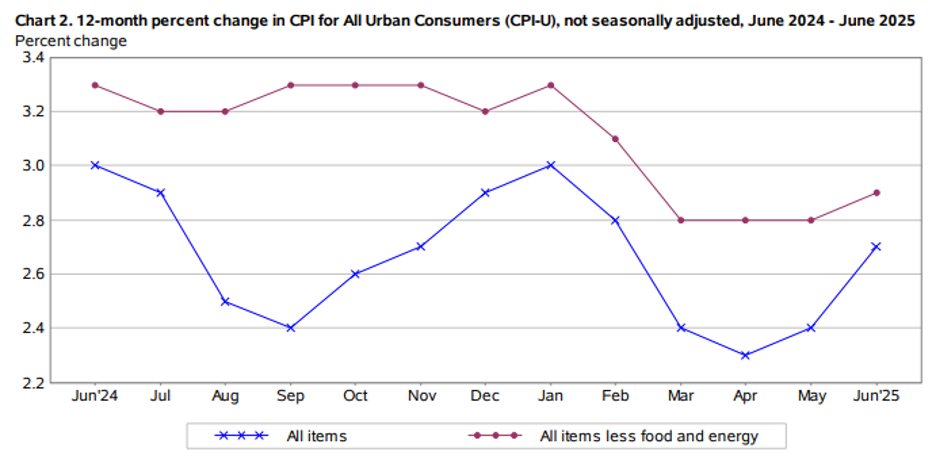
The June inflation report in the U.S. showed a modest monthly uptick, while underlying price pressures remain contained. The Consumer Price Index (CPI) rose 0.3% in line with expectations, while the annual rate increased to 2.7%, just above the 2.6% forecast. Core inflation rose 0.2% month-over-month and 2.9% year-over-year, showing no major surprises. 

Where are the biggest shifts? 

  • Food and durable goods saw a 0.3% increase, driven by higher prices for coffee, beverages, and household items. In contrast, prices for new and used cars continued to decline, helping ease core inflation. 
  • Services and energy were mixed. Gasoline prices rose 1.0% after four months of declines, and the housing index climbed 0.3%. Meanwhile, hotel and air travel costs edged down slightly, pointing to still-moderate demand. 

Despite the overall uptick, the market remains cautious. Attention is now on the potential impact of new tariffs set to take effect in August, particularly affecting electronics, apparel, and automobiles. 

Market implications: 

Markets are not expecting rate cuts before September, as they assess the effects of new tariffs amid ongoing political pressure for a more accommodative monetary policy. 

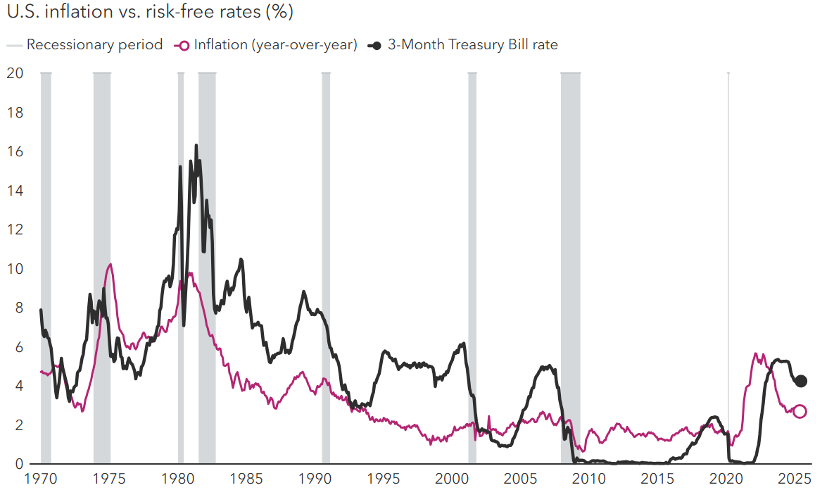
Annual headline inflation rose from 2.4% in May to 2.7% in June, while core inflation edged up from 2.8% to 2.9%. 

Ponte en contacto con nosotros

Receive the best financial market news

Cookie Policy

We use our own and third party cookies to improve our services and show you advertising related to your preferences, by analyzing your browsing habits. By continuing, you confirm that you have read and accept this policy.