Uriel Loredo

S&P 500 Earnings Outlook — 3Q 2025

The S&P 500 shows resilience heading into 3Q 2025, with reasonable earnings growth expectations despite a challenging macroeconomic backdrop. Below are the main takeaways for the upcoming earnings season: 

Earnings Growth 

  • Earnings (EPS) are projected to grow 7.9% YoY in 3Q 2025. If confirmed, this would mark the ninth consecutive quarter of growth for the S&P 500. As of June 30, the growth estimate stood at 7.3%
  • Six sectors have seen upward revisions to estimates, contributing to stronger earnings expectations. 

Sector Growth 

  • Eight of the eleven sectors are projected to post annual growth, led by Information Technology, Utilities, Materials, and Financials
  • Three sectors are expected to report annual declines, mainly Energy and Consumer Staples

Revenues 

  • Revenues are expected to grow 6.3% YoY, compared to the 4.8% projection as of June 30
  • If confirmed: 
    o This would be the second-largest revenue growth since 3Q 2022 (11.0%), only behind the previous quarter. 
    o It would mark the 20th consecutive quarter of revenue growth for the index. 

Valuation 

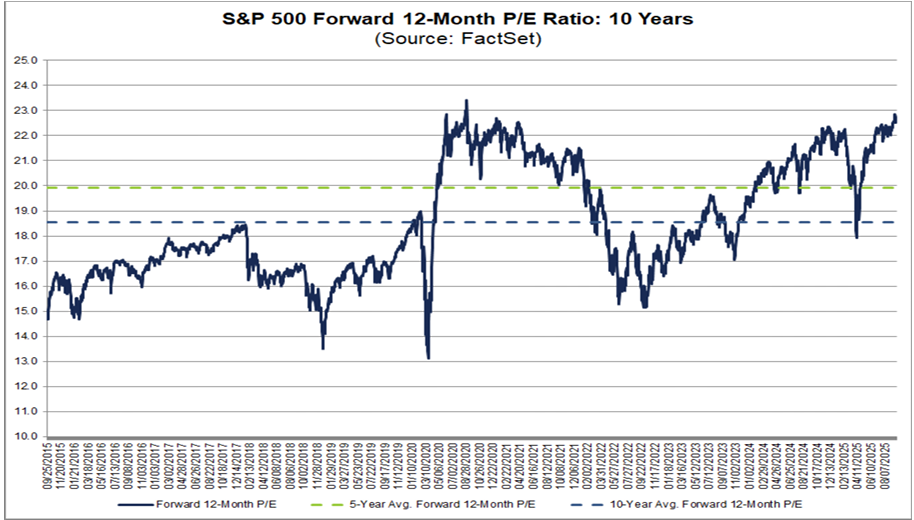
  • The S&P 500 forward 12-month P/E multiple stands at ~22.5x, above the 5-year average (19.9x) and the 10-year average (18.6x). 
  • This suggests that while earnings growth continues, valuations remain tight with much optimism already priced in

Key data points for the quarter: 
☑ EPS growth estimate +7.9% YoY in 3Q 2025 (vs. 7.3% as of June 30) 
☑ Six sectors with upward revisions 
☑ 8 of 11 sectors projected to grow 
☑ Revenues +6.3% YoY (vs. 4.8% as of June 30) 
☑ 20th consecutive quarter of revenue growth 
☑ Forward 12-month P/E ~22.5x (vs. 19.9x 5-year avg. and 18.6x 10-year avg.) 

Corporate performance remains resilient, with earnings growth expectations of 10.8% in 2025 and 13.8% in 2026 — outlooks that investors will closely monitor in a context of valuations above historical averages. 
Source: FactSet 
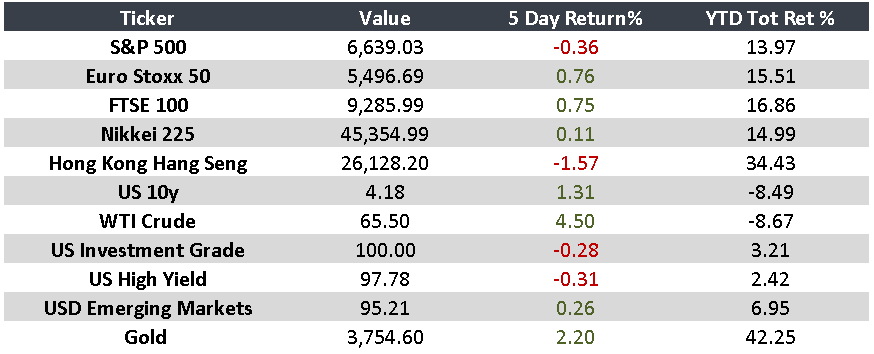
Global Economic Outlook: Mixed Signals and Upward Revision

General Summary: In an environment marked by monetary uncertainty and resilient consumption, the latest data and comments from financial authorities show a mixed picture: while the OECD revised global growth forecasts upward, some central banks remain cautious and highlight medium-term risks.

United States

  • Fed Governor Stephen Miran stated that interest rates are too high and should be cut by up to 200 bps.
  • Jerome Powell warned that equity valuations remain elevated and the path to rate cuts is uncertain.
  • Q2 GDP was revised upward to 3.8% annualized, supported by consumer spending.
  • OECD projects global growth of 3.2% in 2024 and 1.8% for the U.S. in 2025.

Europe

  • UK retail sales rose 0.5% in August.
  • Eurozone business activity reached its fastest pace in 16 months, led by Germany’s service sector.
  • The Swiss National Bank held rates at 0% and warned about the potential impact of U.S. tariffs through 2026.

Japan

  • Manufacturing contracted at the sharpest pace in six months.
  • The services producer price index rose 2.7% YoY in August.

China

  • Donald Trump advanced plans for U.S. investors to acquire TikTok’s U.S. operations from ByteDance, valued at $14 billion.

Mexico

  • Banxico cut the policy rate to 7.5%, the lowest level in three years.
  • Inflation in the first half of September stood at 3.74% YoY, in line with expectations.
  • OECD revised growth to 0.8% in 2024 (from 0.4%) and to 1.3% in 2026 (from 1.1%).

“The greatest enemy of a good plan is the dream of a perfect plan. Stick to the good plan.” — John C. Bogle

Key Events:

  • U.S.: Consumer Confidence — September 30
  • U.S.: Employment Report — October 03

Monitor

Central Banks Set the Tone for the Week

Recent economic data and monetary policy decisions highlight diverging dynamics in the global landscape. From the Fed’s first rate cut of the year to slowing momentum in China and persistent inflation in the United Kingdom, markets are navigating a complex environment. 

United States: 

  • In the United States, the Federal Reserve delivered its first rate cut of the year, while retail sales surprised to the upside. 

Europe: 

  • In the United Kingdom the inflation remained elevated. 
  • In Germany  investor´s confidence improved unexpectedly. 

Asia: 

  • China showed a slowdown in consumption and industry. 
  • Japan recorded a sharp drop in exports to the U.S. 

Latin America: 

  • Brazil kept its benchmark rate unchanged. 
  • Mexico advanced with USMCA consultations and issued bonds to finance PEMEX. 

“I’ve usually used the phrase stay the course as one of the great rules of investment success.” — John C. Bogle 

Key Upcoming Events 

  • In the United States, several Fed members are scheduled to speak — 09/22–24 
  • In the United States, the final revision of Q2 2025 GDP will be released — 09/25 

Monitor

Fed cuts rates for the first time in 2025, cautious outlook

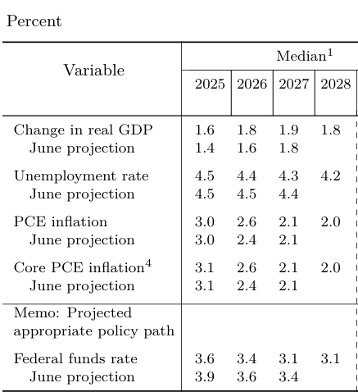
The Federal Reserve lowered its benchmark rate to a 4.00%–4.25% range, in line with expectations. The decision was nearly unanimous, with only one dissent. Projections point to two additional cuts before year-end, which would bring the average rate to 3.6%.  

For 2026, the Fed anticipates just one more adjustment. While inflation and unemployment forecasts remained unchanged, Jerome Powell acknowledged a substantial slowdown in labor demand and job creation. 

The Fed confirms a policy shift but with caution. The bias remains restrictive: only three cuts are projected through 2026. Markets will closely monitor upcoming inflation and employment data. 

FED Indicators Update (September vs. June)

Source: Federal Reserve.

Market Outlook and Positioning

The stability of inflation and weakness in employment have raised expectations for a more accommodative monetary environment. Combined with the trade agreements reached so far and easing tensions with China, this has boosted investor optimism. 

Here’s a summary of key developments: 

Market Performance 
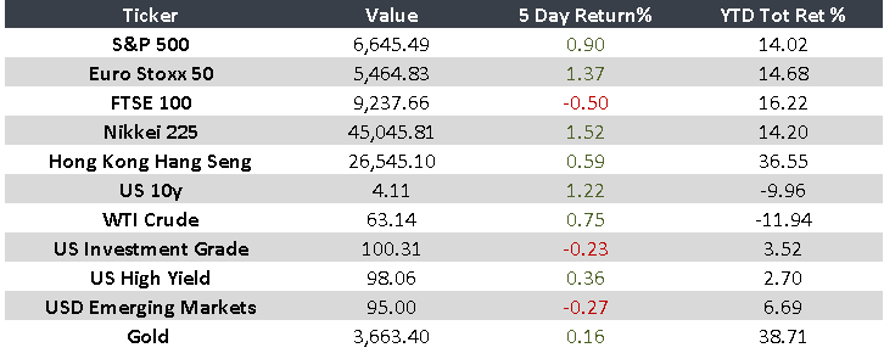
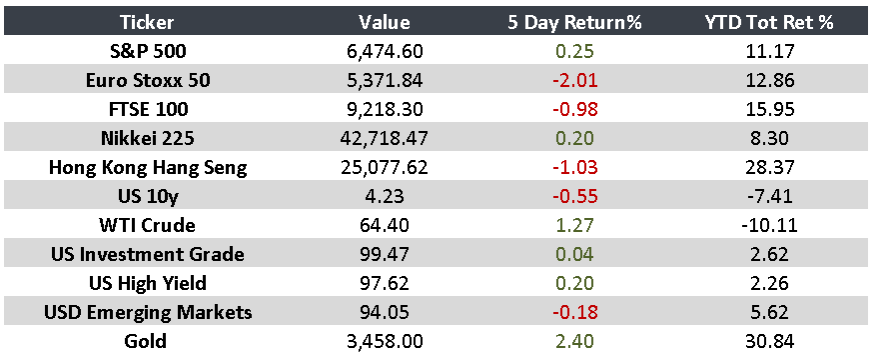
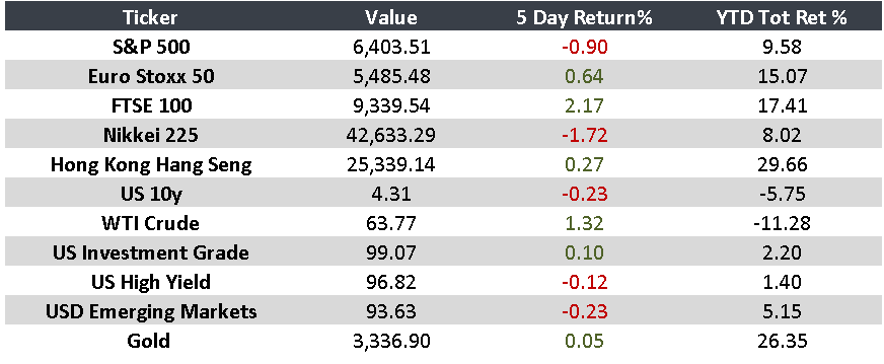
After a challenging first half of the year, the S&P 500 and Nasdaq have posted double-digit gains year-to-date. 

Valuation 
The S&P 500’s valuation remains high, with a forward P/E of approximately 22x. 

Strategy and Positioning 
While the corporate environment could gain momentum from fiscal and monetary stimulus, we maintain a neutral tactical stance on Large Cap equities. 

Key Events to Watch 

  • Employment trends and potential interest rate cuts. 
  • Corporate earnings growth as the year draws to a close. 

Inflation, Employment, and Fiscal Adjustments in Focus

U.S. inflation came in above expectations, but declines in producer prices and weak employment data reinforced expectations of a rate cut. In Latin America, Mexico and Brazil outlined new fiscal plans, while Europe and China continue to show trade fragility. 

  • United States: Inflation rose 0.4% in August, but the PPI fell 0.1%, reinforcing expectations of a rate cut. Together with weak employment data, this has fueled anticipation of the first cut since last year. 
  • Europe: German exports fell 0.6% month-over-month, including an 8% drop to the U.S. The ECB kept rates unchanged, while France faces new political challenges with the appointment of a new prime minister. 
  • China: Exports rose 4.4% year-over-year, below the 5% forecast. Inflation fell -0.4% YoY, while producer prices dropped 2.9% YoY, deepening the disinflationary trend. 
  • Japan: Q2 GDP was revised upward to 2.2% annualized, driven by stronger private consumption and inventory buildup. 
  • Brazil: Inflation eased to 5.13% YoY. While headline prices declined 0.11% MoM, services remain under pressure. 
  • Mexico: The 2026 economic package projects a lower deficit (4.16% of GDP) and growth between 1.8% and 2.8%. Pemex will receive $14 billion in support, and new tariffs on Chinese vehicles are under consideration. 

“Time is your friend; impulse is your enemy.” — John C. Bogle 

Key Events: 

  • U.S. Retail Sales — 09/16 
  • U.S. Monetary Policy Announcement — 09/18 

Monitor

Mixed data and signals of rate cuts

Markets remain attentive to mixed signals on inflation, trade, and monetary policy. 

In a week marked by diverging economic data and monetary policy expectations, here are the key points investors closely followed: 

United States 

  • Manufacturing contracted for the sixth consecutive month in August. 
  • Fed Governor Christopher Waller expressed support for starting a rate-cut cycle in September, leaving room for further adjustments. 
  • Markets are pricing in a 96% probability of a 25 bps cut at the September 18 meeting. 
  • Employment slowed in August, with the unemployment rate edging up to 4.3% 

Europe 

  • Manufacturing expanded in August for the first time since 2022. 
  • Inflation ticked up slightly to 2.1% YoY, driven by unprocessed food and a smaller decline in energy costs. 

Asia 

  • Japan’s manufacturing fell again in August due to weaker foreign demand and U.S. tariffs. The BoJ indicated hikes may continue, though without urgency. 
  • China, the manufacturing PMI saw its fastest growth in five months, and services posted their best performance in over a year, supported by domestic consumption. 

Latin America  

  • Brazil, the government completed its third external debt issuance of the year, including 30Y bonds at 7.5% and 5Y bonds at 5.2%. 
  • Mexico, remittances fell 4.7% YoY in July, though they remain at historically high levels. Banxico raised GDP forecasts to 0.6% for 2025. Pemex launched a bond buyback of up to USD 9.9B, with a deadline of September 30. 

“Our favorite holding period is forever.” — Warren Buffett 

Upcoming Key events:  

  • China export data — 09/08 
  • U.S. inflation data — 09/11 

Monitor

2Q25 earnings season: strong results, underlying risks

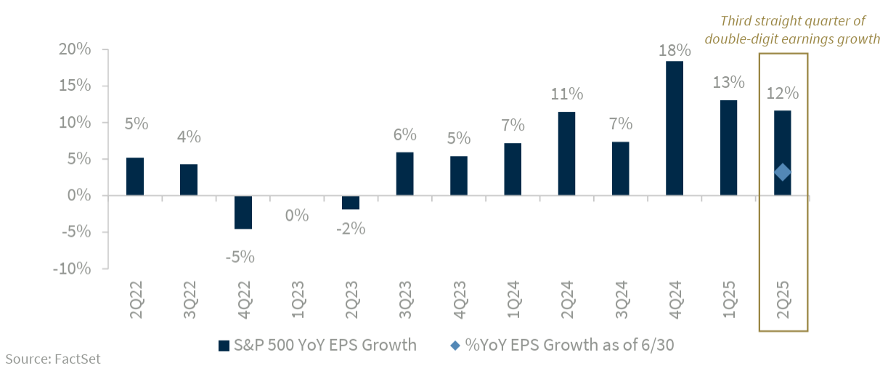
The second-quarter earnings season closed with results better than expected. 81% of S&P 500 companies beat estimates, with aggregate annual earnings growth of 12%. Nvidia stood out with a +45% increase in earnings, while Technology, Financials, and Industrials led the way, driven by artificial intelligence and energy demand. 

Key data from the quarter:

  • 81% of companies beat expectations
  • +12% annual earnings growth
  • Nvidia: +45% earnings growth 
  • Consumer Staples, Energy, and Materials faced headwinds from tariffs and FX

Consumers remain resilient, though spending is becoming more selective. With elevated valuations, the market is now watching whether corporate earnings can sustain current prices in an increasingly uncertain global environment. 

Source: Raymond James –  FacSet.

Markets Repositioned: Tariff Impacts and Mixed Data

Global markets reacted this week to renewed trade tensions, macroeconomic revisions, and political moves that increased uncertainty over the global economic outlook. In the U.S., stronger-than-expected data was overshadowed by political interference. In Europe, confidence indicators showed a fragmented recovery. Asia remains cautious amid weak industrial growth, while Latin America faces rising trade and political pressures. 

United States: 
• GDP for Q2 2025 was revised up to 3.3% annualized, supported by a 1.6% rise in consumer spending. 
• Jobless claims declined to 229,000. 
• President Trump dismissed Fed Governor Lisa Cook over alleged mortgage fraud, raising concerns about central bank independence. 
• A 50% tariff on Indian exports went into effect, impacting $48.2 billion in trade. 

Europe: 
• Germany’s IFO business confidence index reached a 15-year high. 
• However, GfK consumer confidence declined for the third straight month. 
• The EU proposed lifting tariffs on U.S. industrial goods, including retroactive cuts on automobiles. 
• UK producer prices rose 1.9% YoY in June, the highest in two years. 

Asia: 
• Japan downgraded its corporate earnings outlook due to U.S. trade policies. 
• In China, industrial profits dropped 1.5% in July, despite a trade truce with the U.S. 

Argentina: 
• The Central Bank raised the reserve requirement by 3.5 percentage points to 48.5% amid electoral tensions and corruption allegations. 

Brazil: 
• Created 129,775 formal jobs in July, the lowest monthly figure since March. 
• Finance Minister Haddad may challenge U.S. tariffs in court. 

Mexico: 
• Steel exports to the U.S. dropped 16.6% YoY in H1. 
• New tariffs on Chinese imports planned in the 2026 budget proposal. 
• Mexico and Brazil signed agreements on biofuels and competitiveness during VP Alckmin’s visit. 

“Know what you own, and know why you own it.” — Peter Lynch 

Upcoming Key Events: 

• U.S.: ISM Manufacturing Index – September 2 
• U.S.: Employment report – September 5 

Monitor

Markets on pause, expectations in motion 

The third week of August was marked by a modest flow of economic data, yet key signals began to shape the global monetary outlook. In the U.S., housing starts and building permits posted moderate gains, while the Fed minutes revealed ongoing concerns about inflation. Powell’s latest remarks hinted that conditions may soon warrant a policy rate adjustment. 

In Europe, inflation in the UK rose to its highest level in 18 months, even as Germany confirmed a contraction in its second-quarter GDP. Despite this, analysts expect the Bank of England to consider additional rate cuts before year-end. Meanwhile, Asia showed signs of softness: both China and Japan reported a decline in exports, and China’s youth unemployment remains elevated. 

In Latin America, institutional developments made headlines. Petrobras’ CEO resigned, while Pemex’s credit rating was placed under review following the release of its 2025–2035 strategic plan. As markets enter a more uncertain phase, attention now turns to Jackson Hole, where central bank narratives may set the tone for the remainder of the year. 

  • United States: Fed minutes highlight inflation concerns and labor weakness. S&P affirms ‘AA+’ rating. Housing starts up 2.8%, permits up 0.5%. Powell suggests current conditions could justify a rate adjustment. 
  • Europe: UK may cut rates again, despite 3.8% inflation. Germany contracts. EU limits tariffs on exports to the U.S. 
  • Japan: Exports drop 2.6% YoY; exports to the U.S. fall 10.1%. 
  • China: Youth unemployment rises to 17.8%. Benchmark rates unchanged. 
  • Brazil: Petrobras CEO resigns. 
  • Mexico: Moody’s places Pemex under review. Fitch sees neutral impact. Inflation surprises to the downside; Q2 GDP slightly revised. 

“Don’t bottom fish.” — Peter Lynch 

KEY EVENTS 

  • U.S.: Consumer Confidence → August 25 
  • U.S.: Q2 GDP Release → August 28 

Monitor

Ponte en contacto con nosotros

Receive the best financial market news

Cookie Policy

We use our own and third party cookies to improve our services and show you advertising related to your preferences, by analyzing your browsing habits. By continuing, you confirm that you have read and accept this policy.