Uriel Loredo

December Brings Encouraging Signs in Inflation 

Core inflation shows signs of deceleration, while shelter costs register their lowest growth rate since 2022. 

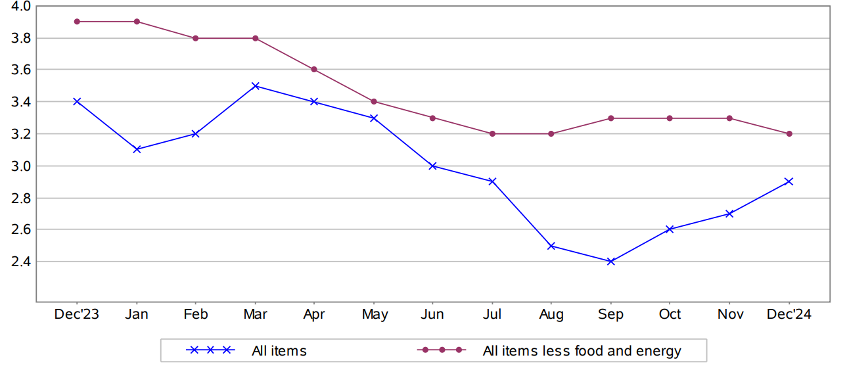
The Consumer Price Index (CPI) rose by 0.4% in December, aligning with market expectations. Over the past 12 months, headline inflation increased by 2.9%. The Core CPI, which excludes food and energy, showed signs of deceleration with a 0.2% monthly rise, the lowest in four months. On an annual basis, it dropped to 3.2%.  

Key components include: 

  1. Energy: Contributed 2.6% to the monthly increase, driven by a 4.4% rise in gasoline prices. 
  1. Food: Prices rose by 0.3% in December, with annual variations of 1.8% for food at home and 3.6% for food away from home. 
  1. Shelter: Increased by 0.3%, marking its smallest annual variation (4.6%) since January 2022. 

These figures provide some relief for the Fed, reflecting a slowdown in core prices, which could pave the way for further rate cuts in 2025. For now, the rate is expected to remain between 4.25% and 4.50% at the upcoming January meeting. 
 

Annual Variation (%) of the Consumer Price Index (CPI): General and Core CPI 
Source: US Bureau of Labor Statistics 
Economic Report: Global Insights for 2025

Key indicators mark the beginning of 2025: inflation, employment, and global challenges. 

The beginning of the year brings key data that impacts global markets and investment decisions. Here are some of the main highlights: 

  • United States: Strong job growth with 256,000 new positions in December and a drop in the unemployment rate to 4.1%. However, persistent inflation has pushed 10-year treasury yields to 4.74%. 
  • Europe: Inflation in the Eurozone rose to 2.4% annually in December, with Germany reporting figures above the ECB’s target. Economic activity continues to contract, reinforcing challenges in the region. 
  • Asia: In China, government measures to boost household consumption include subsidies for appliances and digital goods. In Japan, growth in services has been driven by local demand. 
  • Latin America: In Mexico, annual inflation of December hit its lowest level since 2021 (4.21%), opening the door for potential rate cuts. In Argentina, the country risk fell to its lowest level since 2018, reflecting increased confidence in its assets. 

Key events in the coming weeks 

  • In China, international trade figures will be released on 01/13. 
  • In the U.S, inflation and retail sales data will be released on 01/15–16. 

Monitor 

Artificial Intelligence: Opportunities and challenges on the horizon 

The rise of AI presents transformative opportunities and challenges that investors need to consider.

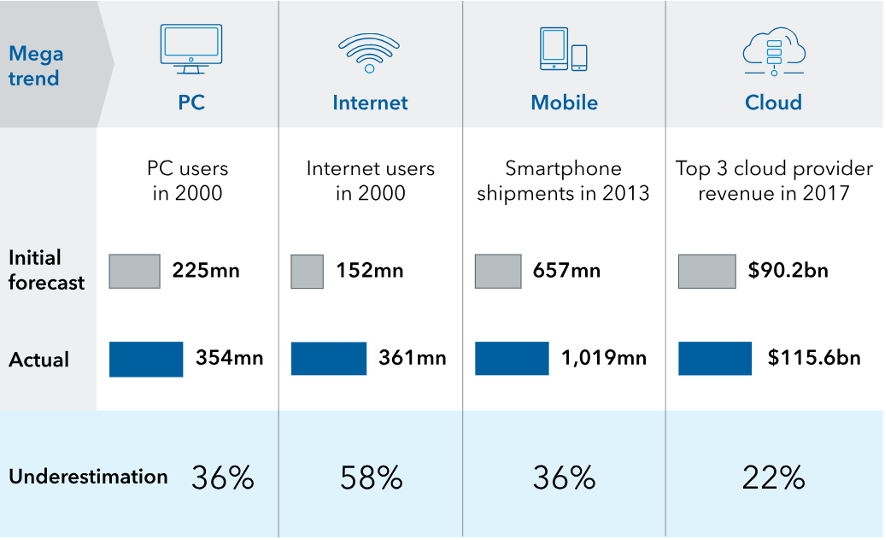
Artificial intelligence (AI) continues to be a central topic in the global tech landscape. Major companies such as Amazon, Alphabet, Meta, and Microsoft have announced investments of up to US$500 billion over the next three years, a move reminiscent of the internet boom of the 90’s. 

While short-term expectations tend to be optimistic, analysts agree that the true potential of AI will unfold over the long term. With applications ranging from semiconductors and cloud services to language models and end-user tools, AI’s impact could be described as “immeasurable.” 

However, this technological revolution is not without its challenges. Increasing demand for energy and materials like copper could create bottlenecks, while the risk of overcapacity and signs of false demand could impact return-on-investment projections. 

AI is expected to evolve in two phases: an initial phase driven by consumer adoption, and a longer phase focused on enterprise integration. This highlights the importance of distinguishing between current enthusiasm and sustainable long-term opportunities. 

Technological development tends to be overestimated in the short term, while its long-term potential is often underestimated. 

Source: Capital Group  

Key economic and market developments: A global perspective.

The first week of the year highlighted the resilience of the housing market in the U.S. and contractions in manufacturing in Europe and Asia. Key points:

Weekly Summary 

United States: The week was marked by low market activity due to New Year celebrations. Regarding economic data: Pending home sales in November reached their highest level in 21 months and home prices increased by 3.6% year-over-year. 

Europe: In Germany and France, industrial activity declined in December. Similarly, in the United Kingdom, manufacturing activity contracted at the fastest pace in 11 months. 

Asia: In China, President Xi Jinping reiterated the need for more proactive and effective macroeconomic policies in 2025 to counter economic slowdown. 

Latin America: According to the Bank of Mexico, international reserves hit a historic high in 2024, totaling $228.789 billion and PEMEX reported a 35% decrease in oil shipments to the U.S. through November of last year. 

Important events in the next weeks 

  • In the United States, the ISM Services Index will be released on 01/07. 
  • In the United States, employment indicators will be published on 01/10. 

Monitor 

Q4 2024 quarterly earnings season and 2025 Perspectives. 

Expectations for the S&P 500 in 2024 and 2025 reflect strong growth, with significant gains projected across multiple sectors. 

S&P 500 Outlook for Q4 2024 

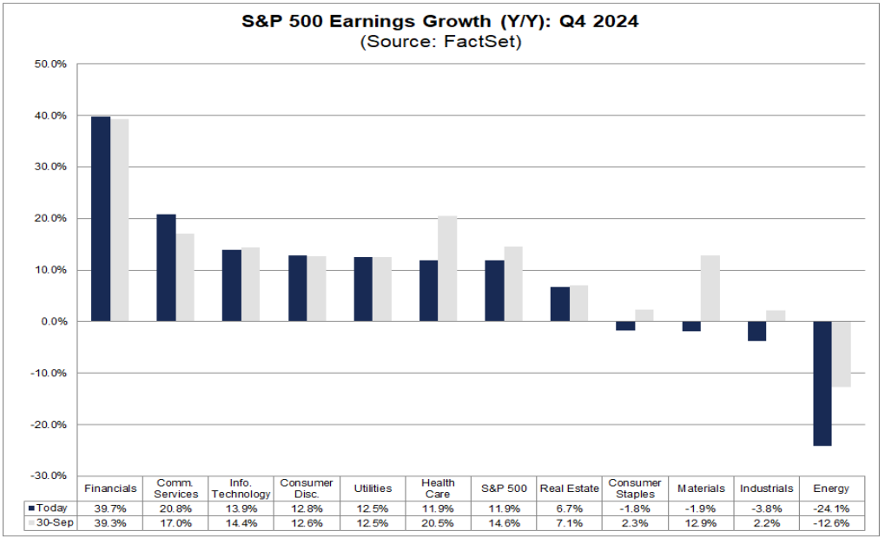
As is customary, JP Morgan will kick off the corporate earnings season in mid-January. However, it is notable that estimated earnings for the S&P 500 in the fourth quarter remain below initial expectations. Despite this decline, the index could still achieve its highest year-over-year (YoY) earnings growth rate in three years, currently estimated at 11.9%. This growth would bring the full-year 2024 earnings increase to 9.4% YoY. 

If confirmed, this figure would represent the strongest YoY earnings growth since Q4 2021. Additionally, seven out of the eleven sectors in the index are projected to report YoY growth, with Finance, Communication Services, Technology, Consumer Discretionary, Utilities, and Health Care leading the way. Conversely, four sectors are expected to see a YoY decline in earnings, with Energy being the only one forecasted to post a double-digit drop. 

What About 2025? 

Looking ahead, analysts anticipate robust earnings growth for the S&P 500 in 2025, projecting nearly 15% YoY growth, well above the 10-year historical average of 8%. Interestingly, companies outside the “Magnificent 7” group (Google, Amazon, Microsoft, Apple, Tesla, Meta, and Nvidia) are expected to show significant improvement, with earnings growth estimated at 13% for 2025. 

Key Takeaways 

The evolution of the Q4 earnings season and the start of Q1 2025 will be crucial. Investors have displayed considerable optimism in recent months, betting on the persistence of a favorable environment for the corporate sector. 

Expected annual earnings growth for the S&P 500 in Q4 2024 


Source: Facset – Earnings Insight 

2025 Perspectives: Analysis of global markets and economic landscape

Discover our annual report ‘2025 Perspectives’ and the key insights for the upcoming year.

The final stretch of 2024 continues to reflect an outstanding performance in the markets, maintaining the positive trend that has prevailed throughout most of the year. This growth has been driven by several key factors that have strengthened global stability:

  • Disappearance of political uncertainty: The resounding victory of Donald Trump and the Republican wave in both chambers have paved the way for a more predictable political environment.
  • Interest rate reductions: The Federal Reserve has initiated a cycle of benchmark rate cuts, creating a favorable environment for investments.
  • Strong earnings performance: Corporate financial results have exceeded expectations, generating a positive balance for the year.

Looking ahead to 2025, the new political agenda is expected to focus on potential tax cuts, reduced regulation, and policies to stimulate the domestic economy. However, the implementation of these measures could present challenges, such as:

  • Trade tensions.
  • A higher public deficit.
  • Rising inflation and higher interest rates.

These factors may pose a challenge for the Federal Reserve, particularly in a context where inflation has slowed to levels more comfortable for the institution.

In this highly dynamic environment, we are pleased to present our annual report, ‘2025 Outlook’. In it, you will find:

  • The perspective of our Investment Committee on this economic scenario.
  • Expectations for each asset class and region.

We are confident this report will provide valuable insights into the next steps to take and how to optimize your investment strategies.

Key Fed decisions and changes in the global economy

Summary of key events: Fed rate cuts, elections in Germany, and mixed data from Asia impacting global markets. 

Week of December 16 to 20 

We bring you the most relevant events shaping the global economic landscape: 

United States: 

  • The Fed reduced its benchmark interest rate to a range of 4.25%-4.5%, returning to December 2022 levels. According to the “dot plot,” only two additional cuts are expected by 2025. 
  • Congress reached a funding agreement to prevent a government shutdown, valid through March, despite opposition from President-elect Donald Trump. 

Europe: 

  • Inflation in the UK reached 2.6% year-over-year in November, aligning with expectations, while the Bank of England kept its rate at 4.75%. 
  • Germany will hold early elections in February following a vote of no confidence in Chancellor Scholz. 

Asia: 

  • Japan’s manufacturing sector is contracting, but its services industry partially offsets the decline. 
  • In China, while industrial production grew by 5.4% year-over-year in November, retail sales hit their weakest point in three months. 

Latin America: 

  • In Brazil, the real fell to its lowest level in two years, while Credit Default Swaps reached a 14-month high due to fiscal uncertainty. 
  • Mexico received a stable rating from S&P, highlighting its macroeconomic prudence and fiscal stability. 

Weekly Summary 
Key events in the coming weeks 

  • In the United States, consumer confidence data will be released on 12/23. 
  • In the United States, the week will be shortened due to the Christmas holiday on 12/25. 

Monitor 

The Fed cuts rates: Less future adjustments  

The Federal Reserve announced a rate cut but adjusted its projections to show less cuts in the coming years.

In a decision anticipated by markets, the Federal Reserve reduced its benchmark rate to a range of 4.25%-4.5%, returning to levels not seen since December 2022. However, the Fed’s message was clear: a more gradual path of adjustments is expected in the coming years. 

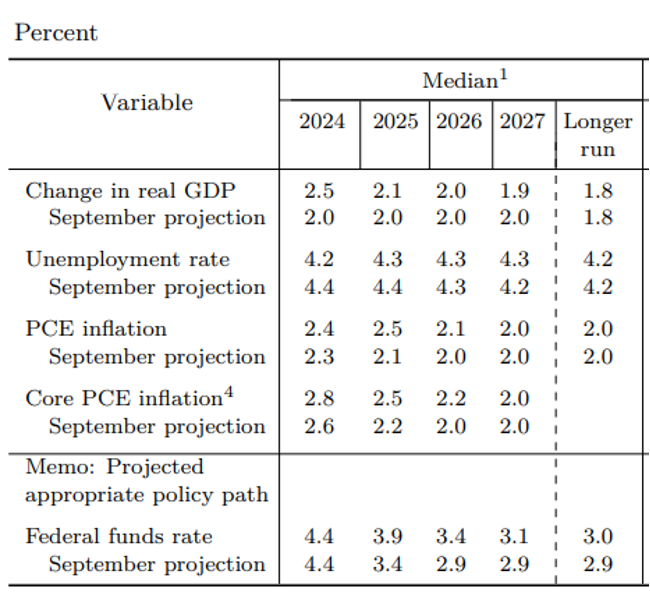
According to the “dot plot”, projections indicate only two additional cuts in 2025, half of what was expected in September. Two more adjustments are projected for 2026, and one more in 2027, with a long-term “neutral” rate estimated at 3%, reflecting a slight upward adjustment. 

Not all Committee members agreed: Beth Hammack, president of the Cleveland Fed, voted against it, continuing the line of dissent that began in November. This marks the first time since 2005 that such a level of opposition has been recorded among the governors. 

The Fed reaffirmed its commitment to monitoring economic data and adjusting monetary policy if necessary. This cautious approach will be key to continuing to balance growth and inflation in the months ahead. 

FED indicators update (December vs. September) 


Source: Federal Reserve 

November Inflation Reinforces Expectations of Rate Cuts. 

The November inflation report could confirm a new interest rate cut.

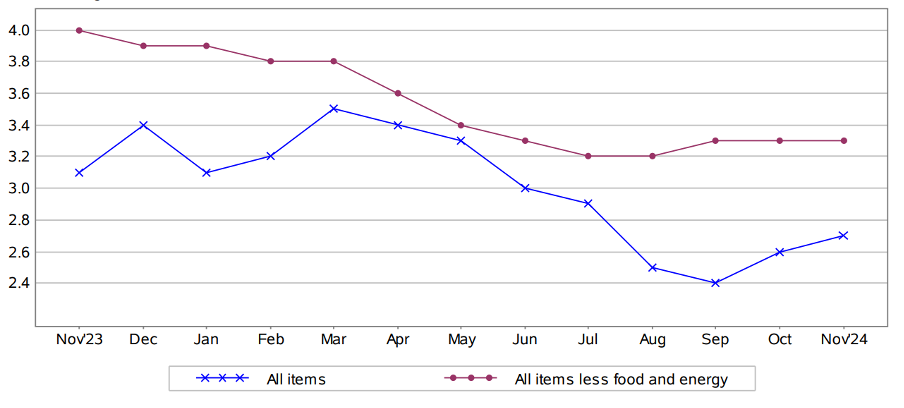
The Consumer Price Index (CPI) for November showed a 0.3% increase, marking a slight acceleration after four consecutive months of 0.2% rises. On an annual basis, overall inflation stood at 2.7%, while core inflation (excluding food and energy) advanced by 3.3%, both figures in line with expectations. 

Among the main factors driving this result was the increase in the housing component (shelter), which contributed nearly 40% of the monthly rise. Additionally, food prices rose by 0.4%, and the energy sector recorded a modest 0.2% increase. 

Excluding food and energy, other components such as housing, used cars, furniture, and healthcare showed significant increases, while the communication index was one of the few to register a decrease. 

In this context, market consensus predicts that the Federal Reserve will implement a 25 basis point rate cut during its next meeting. This move reaffirms the Fed’s commitment to economic stability in an environment of moderate inflation and a strong labor market. 

Expectations for the benchmark interest rate 

Fuente: CME 


Annual change in inflation and core inflation   

Fuente: US Bureau of Labor Statistics 

Key strategies for a successful financial retirement

Essential steps to understand the challenges, benefits, and strategies of a well-planned retirement. 

In a world where life expectancy continues to rise and traditional pension systems are evolving, planning for retirement has become a crucial priority to ensure financial stability and maintain the desired lifestyle in later years. 

Retirement is not just a common financial goal—it’s a universal necessity. Whether you dream of traveling, dedicating time to your passions, or simply enjoying time with your family, having a solid financial plan is essential. Here are some key points to consider: 

  • Increased Longevity: Growing life expectancy means planning for decades of retirement. 
     
  • Shift from Pensions to Personal Savings: As traditional pensions decline, personal savings and investments have become more important than ever. 
     
  • Key Strategies: Diversifying investments, maximizing contributions to plans like a 401(k), and maintaining an emergency fund are critical steps to ensure financial stability. 

Facing challenges such as market volatility or rising healthcare costs requires a disciplined and consistent approach. The good news is that it’s never too late to start. Every step toward structured planning can make a meaningful difference. 

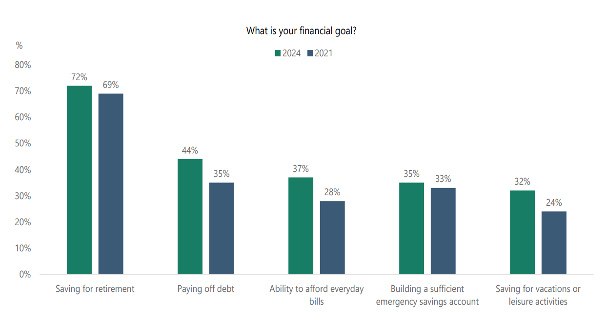
Retirement is widely considered the top financial goal. 

Source: JP Morgan – Apollo  

Ponte en contacto con nosotros

Receive the best financial market news

Cookie Policy

We use our own and third party cookies to improve our services and show you advertising related to your preferences, by analyzing your browsing habits. By continuing, you confirm that you have read and accept this policy.