Uriel Loredo

Key points on the Q4 2024 earnings season

The performance during the season has been encouraging, with corporate profits exceeding expectations.

With more than 75% of S&P 500 companies having reported their results, earnings grew 11% year-over-year, surpassing expectations and marking the fastest pace in three years.

Key data:

• 76% of companies beat estimates, with an aggregate growth of 7%.

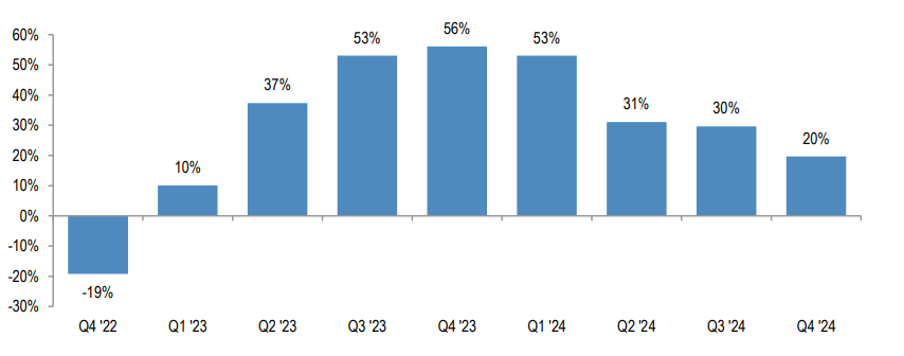
• Excluding tech megacaps, earnings grew 20%, the fastest pace since 2022.

• Megacaps (MSFT, AAPL, GOOGL, META, AMZN) 27% annual growth, with profit margins close to 25%. NVIDIA will report on February 26, with expected growth of 72%.

• The P/E multiple premium of megacaps fell to 30%, below its five-year average (50%).

• AI dominated earnings calls, with tech companies projecting a 49% increase in CAPEX for 2025.

The corporate sector remains resilient, with AI as a key driver. However, the 14% earnings growth forecast for 2025 may face challenges amid a restrictive monetary environment and new trade tariffs.

Tech Megacap Earnings Growth Minus S&P 500 Earnings Growth Excluding Tech Megacaps
Source: JP Morgan
Trump’s new tariffs and inflation data: Key impacts.

New tariffs, rising inflation, and Fed policies shape the global economic outlook.

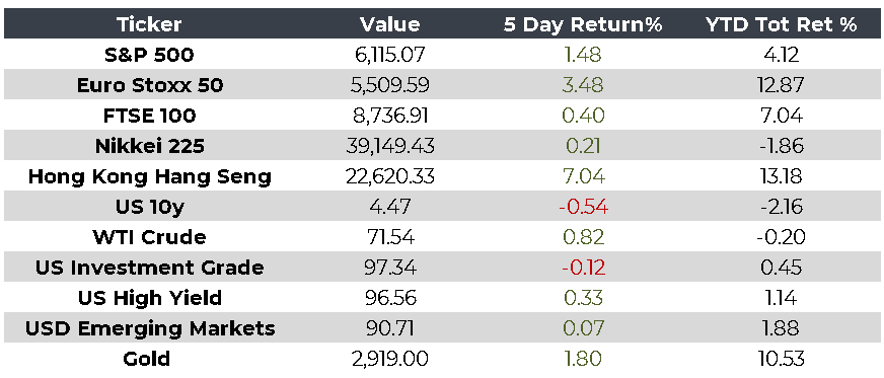
President Trump announced a 25% tariff on steel and aluminum imports from several countries, including Mexico, Canada, and Brazil. Meanwhile, U.S. inflation rose 0.5% month-over-month in January and 3.0% year-over-year, exceeding expectations. Jerome Powell reaffirmed that the Fed will not rush to cut rates anytime soon 
 
Global highlights: 

  • EU: Warned of countermeasures against new U.S. tariffs. 
  • Germany: Exports increased, but industrial production declined. 
  • UK: Unexpected 0.1% GDP growth in Q4 2024. 
  • Japan: Wholesale inflation reached 4.2%, the highest in seven months. 
  • China: Inflation saw its highest increase in five months, but manufacturing remains weak. 
  • Brazil: Adopting a cautious approach to U.S. tariffs; the services sector ended 2024 with weak performance. 
  • Mexico: Rate cuts may continue, while Moody’s warns of risks to the auto sector due to new tariffs. 

Markets will closely monitor the impact of these developments on global monetary policies and key industries. 


Important events in the coming weeks 

  • In the United States, the Fed minutes will be released on 02/19. 
  • In the United States, the Consumer Confidence report will be released on 02/21.  

Monitor 

U.S. inflation surprises in January: What does it mean for markets?

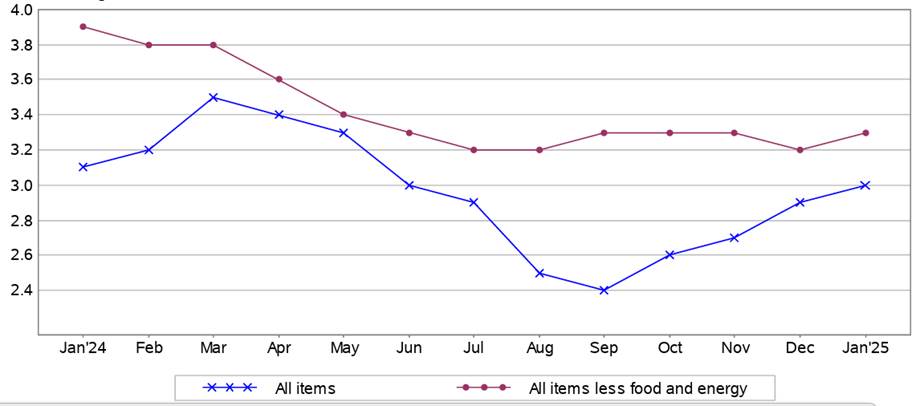
Core inflation rose to 3.3% year-over-year, with the shelter index as the largest contributor. 

The Consumer Price Index (CPI) increased 0.5% month-over-month in January, exceeding the 0.3% forecast. On an annual basis, headline inflation reached 3.0%, also above the 2.9% estimate. 

Key factors driving the increase: 

  • Shelter: +0.4% in January, accounting for nearly 30% of the monthly increase. The annual rise was 4.4%. 
  • Energy: +1.1% month-over-month, with gasoline rising +1.8%. 
  • Food: +0.4% month-over-month; egg prices surged 15.2% due to avian flu. 

Core inflation (excluding food and energy) increased 0.4% month-over-month and 3.3% year-over-year, exceeding estimates. Other notable increases were seen in auto insurance, recreation, and healthcare. 

What’s Next? 

Although inflation has cooled from its 2022 peaks, housing costs continue to exert pressure. Jerome Powell reiterated that the Fed is in no rush to cut rates, and markets now anticipate that the first-rate cut could be delayed until the second half of the year. 

Annual change (%) of the general and underlying consumer price index (CPI) (Core CPI) 

Source: US Bureau of Labor Statistics

Global economic perspectives: What you need to know this week

Global summary: U.S. employment, cuts in Mexico and Europe, and trade tensions.

This week’s global economic highlights:

United States: President Donald Trump temporarily suspended tariffs on Mexico and Canada, while the labor market shows signs of slowing down with 143,000 jobs created in January and an unemployment rate of 4.0%.

• Europe: Inflation in the Eurozone slightly increased to 2.5% year-over-year in January, while the Bank of England cut its rate to 4.5% and adjusted its growth forecast.

Asia: Japan is evaluating rate adjustments to reach its inflation target, and China is facing a tariff exchange with the U.S., impacting its energy and manufacturing sectors.

• Latin America: Mexico lowered its interest rate to 9.5%, supported by an improvement in inflation, and Argentina announced the end of its currency controls by 2026.

We invite you to follow our updates to stay informed about how these events may influence global economic and financial trends.


Key events in the coming weeks:

  • China: January inflation data to be released on 02/10
  • United States: January inflation data to be released on 02/12

Monitor

DeepSeek and Its Impact on the Artificial Intelligence Market

DeepSeek is revolutionizing AI with a more efficient and accessible model, generating significant interest. 

The recent announcement of DeepSeek has captured the attention of the technology and financial industries, signaling a potential disruption in the artificial intelligence and semiconductor sectors. This efficiency has fueled its rapid adoption, accelerating downloads of its application. Below, we highlight some key points. 

Key Highlights: 

Unprecedented efficiency: DeepSeek trains models with only $5 million and 2,000 GPUs, compared to the $100 million and 100,000 GPUs required by current industry leaders. 

Market impact: Following the announcement, NVIDIA and other leading players in the industry saw significant stock losses, reflecting a potential shift in market dynamics. 

Challenges ahead: From national security concerns to regulatory risks and cybersecurity threats, DeepSeek’s path is not without obstacles. 

While it is still early to assess its long-term impact, the evolution of DeepSeek raises key questions about the future of hardware and semiconductors in the AI industry.  

We remain attentive to exploring the implications of this breakthrough together. 

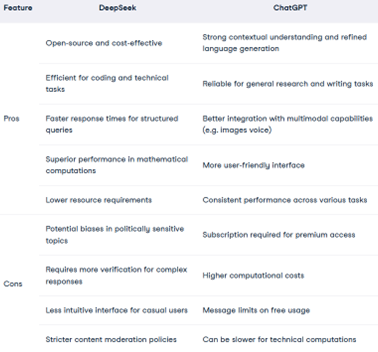
DeepSeek vs. ChatGPT comparison 

Source: Datacamp.com 

Economic perspectives: Key decisions and their global impacts. 

The impact of central bank decisions and global economic performance in early 2025. 

So far this year, global economies have shown mixed signals: 

  • United States: The Fed maintained the benchmark rate at 4.25%–4.5%, while Q4 2024 GDP grew 2.3%, marking a slowdown compared to previous quarters. 
     
  • Europe: The ECB cut the benchmark rate to 2.75% amid economic stagnation in the Eurozone. 
     
  • China: Manufacturing and services activity unexpectedly contracted, reinforcing expectations for new stimulus measures. 
     
  • Mexico: Exports grew 4.1% year-over-year in 2024, while Q4 2024 GDP declined by 0.6%, marking its first contraction since 2021. 

We invite you to analyze this data and consider its implications for your financial and strategic decisions. If you’d like more information or a detailed analysis, please feel free to contact us.


Important events in the next weeks 

  • In the United States, the manufacturing ISM will be released on 02/03. 
  •  In the United States, employment data will be released on 02/07. 

Monitor 

Monetary Policy: The Fed Pauses, but the Market Expects Cuts 

The Federal Reserve holds its benchmark rate steady, but the market anticipates adjustments in 2025. 

As expected, the Federal Reserve (Fed) maintained its benchmark interest rate within the 4.25%-4.5% range. This decision marks a pause following three consecutive cuts since September 2024, totaling a one-percentage-point reduction. 

The Fed’s statement highlighted that economic activity continues to grow at a solid pace, while unemployment remains low and the labor market strong. However, inflation remains somewhat elevated, and the Fed omitted previous references to progress toward its 2% target. 

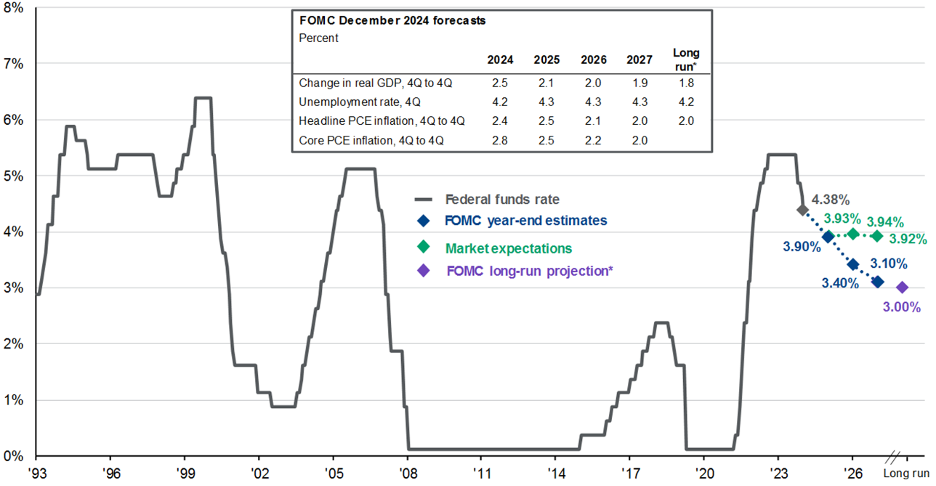
Looking ahead, markets are pricing in a 3.9% rate by the end of 2025, with a 61% probability of at least two quarter-point cuts this year. The first cut could come as soon as the June 18 meeting. 

We will continue monitoring the Fed’s decisions and their impact on the markets. If you’d like more information on how this policy could affect your financial strategies, feel free to reach out to us. 

Expectations for the Fed Funds Rate

Source: JP Morgan 

Global outlook: Economy and politics under new leadership.

Global Analysis: Politics, economy, and key trends in international markets.

The week was marked by the inauguration of Donald Trump as the 47th President of the United States. He signed executive orders on immigration, energy, and security and announced the possibility of implementing a 25% tariff on products from Canada and Mexico, set to take effect on February 1. 

On the economic front, there was a slight increase in unemployment insurance claims. Meanwhile, the Q4 2024 earnings season had a strong start, with S&P 500 companies reporting an initial 5% growth in sales and a 17% increase in profits.  

In other global markets: 

• Europe: The ECB is expected to announce a rate cut next week, while consumer sentiment shows improvement. 

• Japan: The Bank of Japan raised its benchmark rate to 0.5%, aligning with expectations. 

• China: The People’s Bank of China kept interest rates unchanged for the third consecutive month. 

• Mexico: Inflation fell to its lowest level since 2021, and the IMF revised its 2024 growth forecast upward. 

These developments highlight the importance of staying vigilant regarding key movements in global politics and economics. 


Important events in the coming weeks 

  • In the United States, the Fed’s monetary policy announcement will be on 01/29 
  • In the United States, Q4 2024 GDP will be released on 01/30 

Monitor 

China: Solid growth, but with challenges in sight. 

China exceeds growth expectations in 2024 but faces significant challenges.

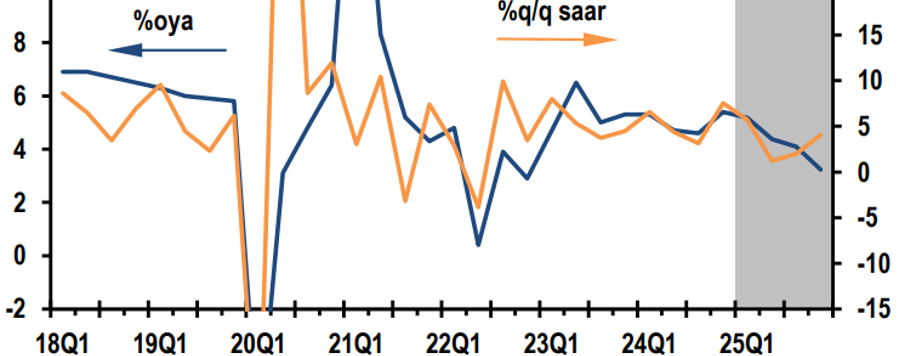
In 2024, China’s economy achieved a 5.0% growth rate, meeting the official target. However, this performance—its weakest since 1990, excluding the pandemic years—reflects an economy heavily reliant on fiscal and monetary stimulus. Key highlights include: 

  • Inflation: Increased by only 0.2%, signaling weak domestic demand. 
  • Industrial production: Grew 5.8%, led by high-tech sectors (+8.9%). 
  • Real estate: Declined 10.6%, highlighting weakness in the sector. 
  • Demographics: Population decreased 1.39 million, exacerbating the aging challenge. 
  • International trade: Exports grew 7.1%, and imports 2.3%. 
  • Unemployment: Urban unemployment rate remained stable at 5.1%. 

Despite these figures, China’s economy continues to face significant pressures, including weak domestic consumption, a persistent real estate crisis, and ongoing trade tensions with the U.S. Analysts anticipate that the government will announce new stimulus measures, although fiscal and monetary policy options are increasingly constrained. 

We will closely monitor the growth target China sets in the near future and assess the impact of its measures on the global economy. 

Annual and quarterly GDP evolution 

  • oya: Refers to year-over-year variation. 
  • Q/Q: Refers to quarter-over-quarter variation. 

Source: JP Morgan 

Global economic outlook: Key data from the United States, Europe, and more. 

Financial results and inflation key events so far this year. 

The global economic outlook continues to provide crucial insights for understanding market trends. Here’s a summary of the most relevant data: 

  • United States: The Q4 2024 earnings season began with strong reports from JP Morgan, Citi, and other institutions. Meanwhile, inflation closed at 2.9% annually in December, in line with expectations, and retail sales advanced by 0.4%. 
  • Europe: The ECB may continue easing its monetary policy after four rate cuts last year. However, Germany’s economy has experienced two consecutive years of contraction.  
  • Japan and China: Japan is debating potential interest rate hikes, while China showed a recovery in exports with, a 10.7% annual growth. 
  • Latin America: In Mexico, the Plan México was introduced to attract strategic investments, while Argentina ended 2024 with a significant slowdown in inflation, dropping to 117.8% annually. 

Important Upcoming Events:

  • In the United States, Martin Luther King Jr. Day will be commemorated on 01/20
  • In the United States, consumer confidence indicators will be released on 01/24. 

Monitor 

Ponte en contacto con nosotros

Receive the best financial market news

Cookie Policy

We use our own and third party cookies to improve our services and show you advertising related to your preferences, by analyzing your browsing habits. By continuing, you confirm that you have read and accept this policy.