Uriel Loredo

Weekly Outlook: Employment, Growth, and New Tensions

U.S. employment, inflation in Europe, and export rebounds in Mexico and China. 

Market Highlights 
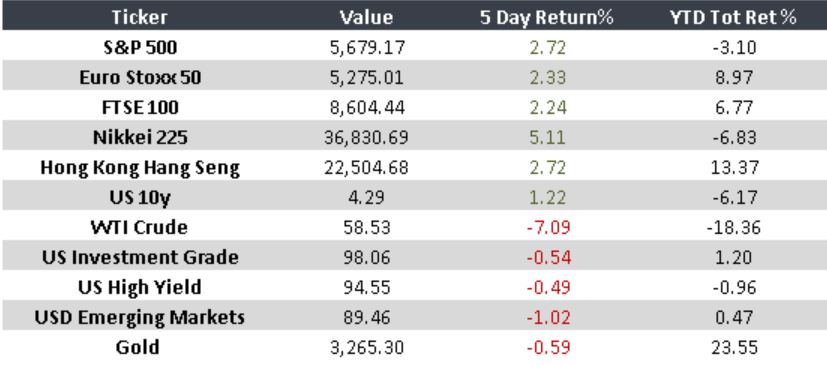
Here’s a summary of the most relevant developments that influenced global markets this week: 

United States 
177,000 jobs were created in April, beating the 138,000 forecast. However, consumer confidence fell to its lowest level in five years, and Q1 2025 GDP contracted by 0.3%. 
Job openings (JOLTS) also dropped to a six-month low. 

Europe 
Eurozone GDP grew 0.4% in the first quarter, exceeding projections. However, consumer inflation expectations rose to 2.9% over the next 12 months. 

China 
The government reaffirmed its commitment to boosting growth through proactive fiscal measures. However, manufacturing activity declined again, reaching a two-year low. 

Brazil 
The Central Bank emphasized a comprehensive approach amid early signs of economic cooling and inflation levels still above target. There’s growing optimism around the ratification of the Mercosur-EU agreement. 

Mexico 
Preliminary Q1 2025 GDP grew 0.2%, avoiding a technical recession. Exports rose 9.6% year-over-year, and the trade surplus reached US$3.443 billion. Still, inflation edged up slightly to 3.96%. 

In investing, adaptability in times of change isn’t just an advantage—it’s essential for uncovering new opportunities. 


Key Upcoming Events 

  • In the U.S., the ISM Services Index will be released – 05/05 
  • In the U.S., the Fed will announce monetary policy – 05/07Forma 

Monitor 

Strategy and diversification: The value of alternative assets

Discover how alternative assets strengthen portfolios in uncertain times. 

The strategic role of alternative investments 

In an increasingly dynamic economic environment, relying solely on traditional stocks and bonds can leave portfolios more exposed to concentration risk and market sensitivity. Alternative assets open opportunities to diversify, hedge against inflation, and enhance long-term resilience. 

How each asset class contributes: 

  • Private credit: Generates attractive income with floating rates that mitigate interest rate risk. 
  • Private equity: Captures innovation and growth opportunities outside the public markets. 
  • Real assets (Real Estate and Infrastructure): Provide stable cash flows, inflation protection, and long-term contracts. 
  • Hedge funds: Reduce volatility and deliver returns with low correlation to traditional markets. 

Rather than simply seeking exceptional returns, the focus is on complementing and strengthening the portfolio with instruments that add true stability and diversification in challenging economic contexts. 

Market implications: 
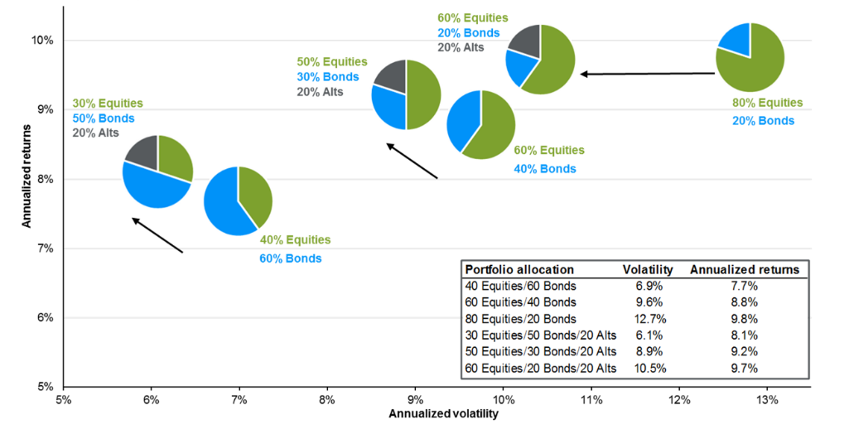
Incorporating alternative investments into traditional stock and bond portfolios can help manage risk and enhance returns. 

Risk–Return Profile of a Traditional Portfolio Including Alternative Investments (Q1 1990 – Q3 2024) 

Source: JP Morgan 

Global Challenges Mount as Markets Seek Stability

Strong U.S. sales and growth in China stand in contrast with ongoing trade tensions. 

Market Highlights 
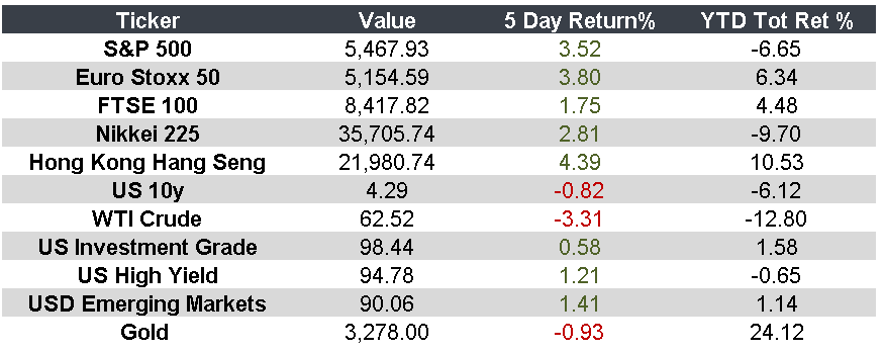
Here’s a summary of the most relevant developments that influenced global markets this week: 

United States 

  • Treasury Secretary Scott Bessent suggested that trade tensions with China could ease in the coming months, though a unilateral removal of tariffs is not under consideration. 
  • The IMF revised its U.S. growth forecast downward to 1.8% for 2025, from a previous estimate of 2.7%. 
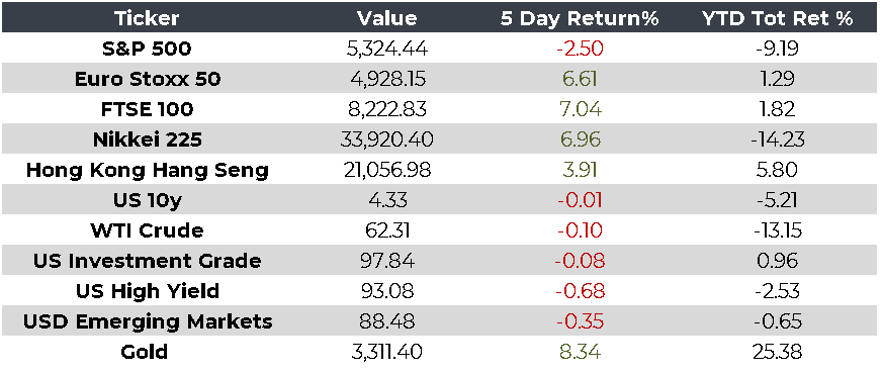
  • Gold prices surpassed $3,500 per ounce for the first time in history. 

Europe 

  • Economic activity in both the eurozone and the U.K. stagnated, impacted by trade-related uncertainty. 
  • Nevertheless, Germany’s Ifo Business Climate Index posted an unexpected increase in April, reflecting improved sentiment. 

China 

  • For the sixth consecutive month, interest rates were left unchanged: the one-year LPR remains at 3.1%, and the five-year LPR at 3.6%. 
  • The Chinese government ruled out resuming trade negotiations with the U.S. while tariffs remain in place. 

Brazil 

  • The Finance Minister dismissed the likelihood of a recession, expressing confidence that global tariffs will not be sustained and emphasizing that inflation is approaching the Central Bank’s target. 

Mexico 

  • Citi revised its 2025 growth forecast downward to 0.2% (from 0.3%) and now anticipates the benchmark interest rate to end the year at 7.75%. 
  • Inflation in the first half of April rose to 3.96%, driven primarily by price increases in fruits and vegetables. 

In investing, adaptability in times of change isn’t just an advantage—it’s essential for uncovering new opportunities. 


 Key Upcoming Events 

  • May 1: ISM Manufacturing Index (U.S.) 
  • May 2: Employment indicators (U.S.) 

Monitor 

Market volatility in perspective: 5 ideas to stay on course

Key insights to stay focused and invest strategically in a changing environment.

Market volatility in perspective: 5 key ideas

The recent 90-day tariff pause has not eliminated uncertainty in the markets. While ups and downs continue, history reminds us that volatility is often temporary and that markets have a remarkable capacity to recover. Here are five key ideas to help maintain perspective and stay focused on your long-term goals:

  1. A long-term view changes everything. Stepping back from day-to-day noise allows for better decision-making. Just like in 2018, markets can bounce back strongly—as they did in 2019.
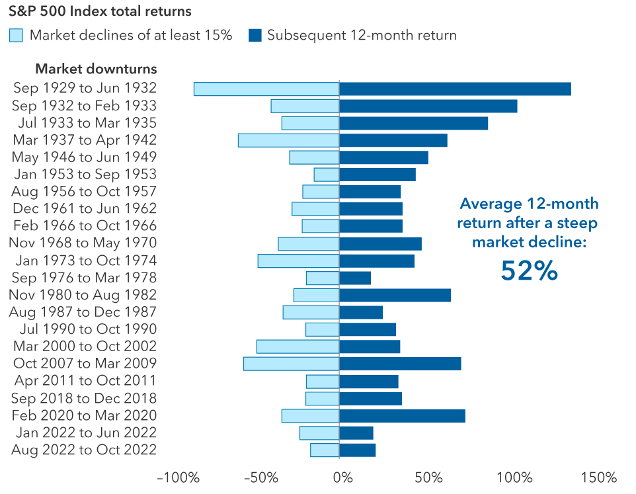
  2. Recoveries often follow declines. After a drop of more than 15%, markets have risen an average of 52% in the following 12 months. Keep the inversion is often wiser than reacting.
  3. Bear markets are shorter than they seem. On average, they last 12 months compared to 67 months of bull markets. Trying to anticipate them may mean missing out on recovery opportunities.
  4. Fixed income brings stability. During equity market corrections, high-quality bonds have shown their defensive role.
  5. Staying invested is the best strategy. Discipline has consistently paid off. A portfolio invested in the S&P 500 over the last decade would have tripled in value despite the COVID pandemic and interest rate hikes.

Market implications: History doesn’t repeat itself. A diversified portfolio and a long-term approach remain the best tools for navigating uncertainty.

Market returns have historically been strong following significant downturns.

Source: CapitalGroup

Strong retail sales in the U.S. and growth in China contrast with ongoing trade tensions

Here’s a quick look at the most relevant developments that shaped markets during this shortened week. 


United States 

  • President Trump is considering temporary exemptions from the 25% tariffs on vehicles and auto parts. 
  • Electronic devices like smartphones and computers have been temporarily exempted. 
  • Retail sales rose 1.4% in March, beating expectations. 
  • Fed Governor Waller noted that the inflationary impact of tariffs would likely be “transitory.” 

Europe 

  • U.K. inflation fell to 2.6% in March, better than expected. 
  • EU leaders believe most tariffs imposed on the bloc will remain in place. 
  • The U.S. may temporarily ease some tariffs, but full removal isn’t expected. 

China 

  • Exports rose 12.4% year-over-year in March, surpassing the 4.4% forecast. 
  • First-quarter GDP grew 5.4% annually, despite ongoing trade tensions with the U.S. 

Brazil 

  • Analysts expect economic growth to slow in the second half of the year, weighed down by high domestic interest rates and global trade friction. 

Mexico 

  • The U.S. will impose a 20.91% tariff on Mexican tomato imports starting in July. 
  • Finance executives warn that Mexico could lose its investment-grade rating by 2026 if trade relations with the U.S. deteriorate and fiscal deficits persist. 

Staying informed is key to understanding the ever-changing environment in which investments operate.


IMPORTANT EVENTS – CALENDAR 

  • April 23: The Federal Reserve’s Beige Book economic report will be released. 
  • April 22–24: Regional manufacturing reports will be published in the U.S. 

Monitor 

Good news: Inflation drops more than expected 

Inflation slowed in March and is moving closer to the Federal Reserve’s target. 

Key highlights from the report: 

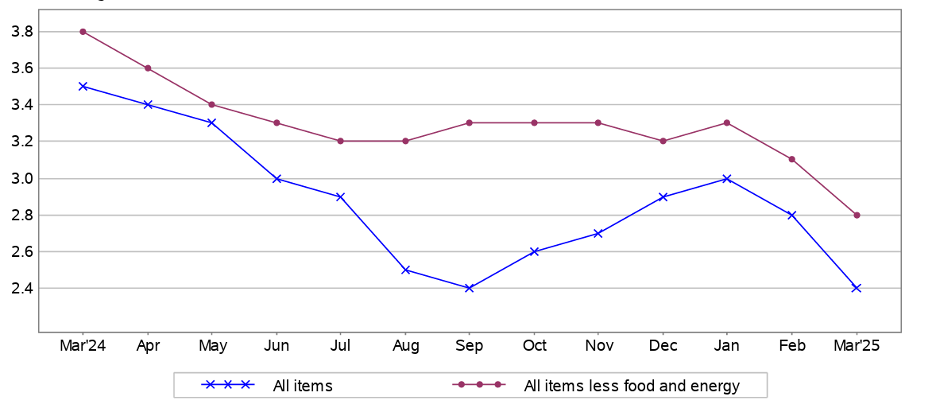
The Consumer Price Index (CPI-U) fell 0.1% in March, marking a positive shift compared to the 0.2% increase in February. This decline reinforces the trend toward more controlled inflation amid a still-challenging monetary policy environment. 

  • Annual inflation: 2.4%, down from 2.8% in February and better than the estimated 2.6%. 
  • Energy: -2.4% monthly, driven by a 6.3% drop in gasoline prices. 
  • Food: +0.4%, with increases both at home and away from home. 
  • Core inflation: +0.1% monthly and +2.8% annually, the smallest increase since March 2021. 
  • Shelter: +0.2% monthly, +4% annually, the lowest rise since 2021. 
  • Other categories: Declines in airfare, used cars, insurance, and recreation. 

The report suggests a gradual yet steady slowdown, bringing inflation closer to the 2% target. However, the Fed remains cautious due to persistent pressures in certain sectors and uncertainty surrounding trade policies. 

Market implications: 
The consensus now expects between three and four federal funds rate cuts (currently at 4.25%-4.50%) throughout the year. No changes are anticipated for the upcoming May 7 meeting. 

Year-over-year percentage change in headline and core inflation 

Source: U.S. Bureau of Labor Statistics 

The U.S. imposes higher tariffs, impacting manufacturing and employment expectations.

U.S. Imposes Global Tariffs 

Here are the key events that influenced market sentiment this week: 

United States 

  • The U.S. announced a new 10% blanket tariff on imports, with reciprocal measures for over 150 countries starting April 9. 
  • Nonfarm payrolls exceeded expectations in March, adding +228,000 jobs, though unemployment rose to 4.2%. 
  • Manufacturing activity contracted for the first time this year, according to the ISM index. 

Europe 

  • Inflation fell to 2.2% year-over-year, in line with expectations. 
  • Markets anticipate a 25-bps rate cut at the ECB’s April 17 meeting. 
  • The European Commission responded to U.S. tariffs and is preparing countermeasures. 

China 

  • The manufacturing PMI reached a 12-month high, driven by a surge in new orders. 
  • The country will face a 54% tariff on its exports to the U.S. and has retaliated with a 34% tariff on U.S. goods. 

Brazil 

  • Industrial production unexpectedly declined by 0.1% month-over-month in February, dragged down by durable goods manufacturing. 

Mexico 

  • February remittances totaled $4.459 billion, down 1% year-over-year. 
  • Mexico and Canada were excluded from the U.S. tariff announcement. 
  • The government introduced an 18-point plan to boost domestic consumption, investment, and social programs. 

In times of volatility, it’s essential not to be swayed by short-term noise—discipline and patience create long-term wealth. 


Important events:

  • April 9: The U.S. Federal Reserve minutes will be released. 
  • April 10: March inflation data will be published in the U.S. 

Monitor

Earnings Season: Resilient Growth Amid Adjustments

S&P 500 earnings rise amid uncertainty.

Key points from Q1 2025 earnings season 

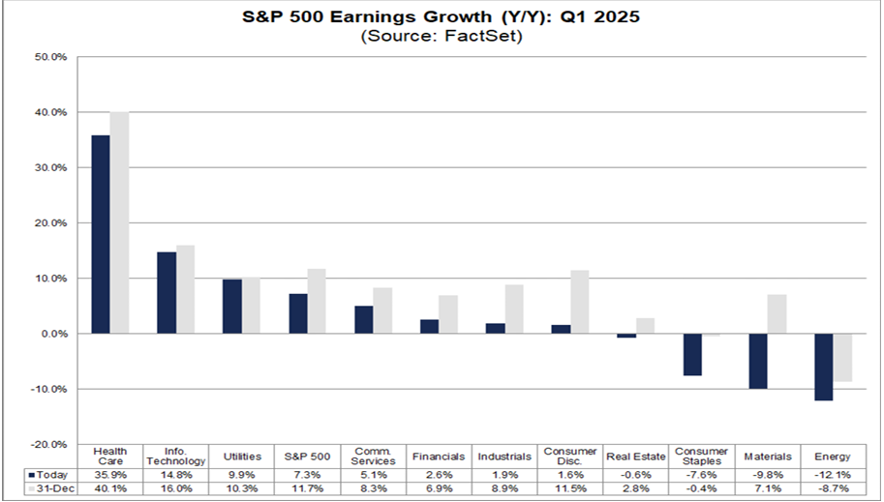
By the end of Q1 2025, analysts have adjusted their earnings expectations. Although the estimated growth has dropped to 7.3% year-over-year from 11.7% at the end of December, the S&P 500 is still on track for its seventh consecutive quarter of expansion. Additionally, revenue growth is expected to reach 4.2%, with net margins at 12.1%. 

The technology, healthcare, and utilities sectors lead earnings growth, while energy and materials decline. Despite current economic uncertainty, corporate performance continues to show positive signs, which could translate into an 11.5% earnings growth for the full year. 

Market implications: 
With the first quarter closing amid volatility due to the potential effects of tariff implementation, investors will turn their attention to the upcoming earnings season. 


S&P 500 year-over-year earnings growth: Q1 2025 

Source: FactSet 

Inflation eases in Mexico and the United Kingdom, while trade tensions with the United States rise. 

Global markets in motion: Uncertainty in the U.S., recovery in Europe, challenges in China, and monetary adjustments in Mexico. 

  • United States 
    Analysts expect S&P 500 earnings to grow 7.7% year-over-year in Q1 2025, the slowest pace since Q3 2023. Trump announced a 25% tariff on all cars manufactured outside the country. Consumer confidence fell amid inflation fears. Q4 2024 GDP was revised upward, showing an annualized growth of 2.4%, driven by consumption. 
  • Europe 
    Economic activity advanced at its fastest pace in seven months, led by the manufacturing sector. In the United Kingdom, inflation slowed to 2.8% year-over-year, better than expected. 
  • China 
    In response to rising tariffs, Premier Li Qiang called for opening global markets. Industrial profits fell 0.3% year-over-year as of February. 
  • Brazil 
    The government considers that conditions may arise to begin interest rate cuts in the second half of the year. 
  • Mexico 
    Inflation in the first half of March moderated to 3.67% year-over-year. In line with expectations, the Bank of Mexico cut the benchmark rate by 50 basis points, bringing it to 9%. 

Staying informed will help you better understand the current macroeconomic context. 


Important events in the coming weeks 

  • April 01: In the United States, the ISM Manufacturing Index will be released. 
  • April 04: In the United States, employment figures will be published. 

Monitor

Understanding Market Corrections – What You Need to Know

A straightforward look at how market corrections happen, what causes them, and how to stay on track when they do. 

Making Sense of Market Corrections 

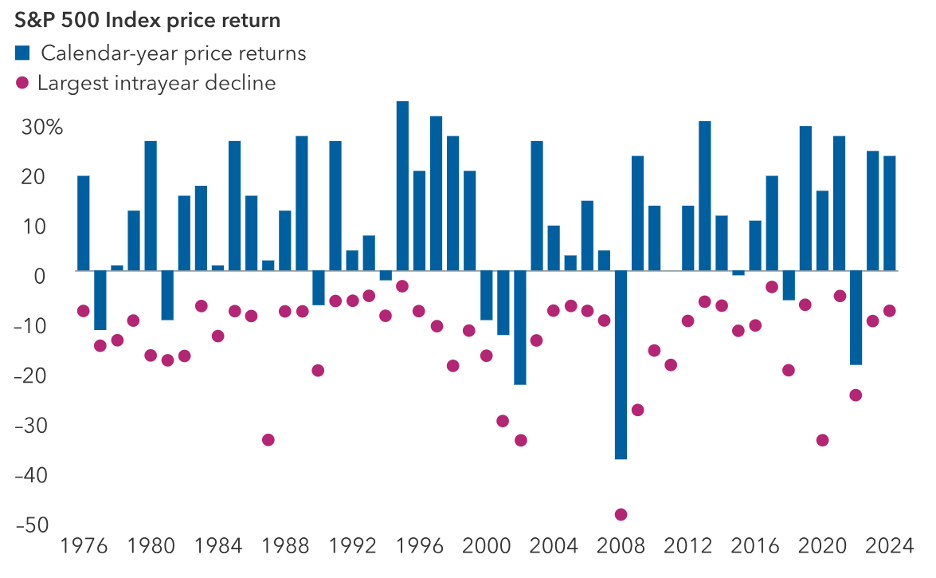
A market correction is a drop of about 10% to 20% from a recent high—and they’re more common than many realize. Historically, the S&P 500 experiences a correction every 18 to 24 months, and in most cases, the market bounces back within four to six months. 

What Do Corrections Look Like? 

  • Mild (10–12%) – Usually triggered by shifts in stock valuations. 
  • Standard (12–17%) – Often tied to interest rate changes or macroeconomic concerns.
  • Deep (17–20%) – Can be caused by financial system stress or major global events. 

What Typically Causes Them? 

  • Fed rate hikes 
  • Rising inflation 
  • Global tensions or conflicts 
  • Lower-than-expected corporate earnings 
  • Market running “too hot” (i.e., overvalued) 

A Few Recent Examples: 

  • 2018 (-19.8%) – Trade war headlines 
  • 2020 (-33.9%) – COVID market shock 
  • 2022 (-25.4%) – Inflation spike and Fed rate hikes 

How to navigate them: 
During these periods, the most important thing is to stick with your investment strategy, stay diversified, and keep focused on your long-term goals. It’s easy to get caught up in dramatic headlines, but making impulsive moves often does more harm than good. 

At the end of the day, getting through a correction is about having a plan, staying disciplined, and remembering that volatility is a normal part of investing. 


Market downturns have occurred every year.

Source: Capital Group

Ponte en contacto con nosotros

Receive the best financial market news

Cookie Policy

We use our own and third party cookies to improve our services and show you advertising related to your preferences, by analyzing your browsing habits. By continuing, you confirm that you have read and accept this policy.