Uriel Loredo

Inflation slows down in May – but no clear signals yet 

May Inflation: A Softer Reading 

The latest U.S. inflation report came in better than expected. Consumer prices (CPI) rose just 0.1% in May and 2.4% over the past year, matching forecasts. Core inflation (which excludes food and energy) also increased by only 0.1%, bringing the annual rate down to 2.8% — both lower than anticipated. 

Gasoline, used cars, and clothing saw notable price drops, while services like housing and insurance continued to show moderate increases. Despite this progress, the Fed has yet to signal that a rate cut is coming anytime soon. 

Market Takeaway: 

Investors are still expecting the first rate cut to happen in September, while keeping an eye on the impact of tariffs and signs of a slowing economy. 

Annual inflation dropped from 3.3% in May 2024 to 2.4% in May 2025, showing a clear slowdown in recent months. 
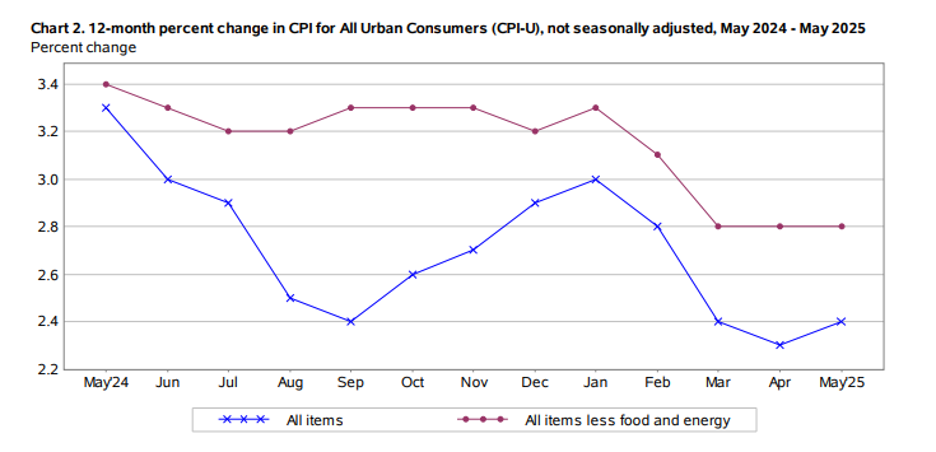
Source: Bureau of Labor Statistics. 
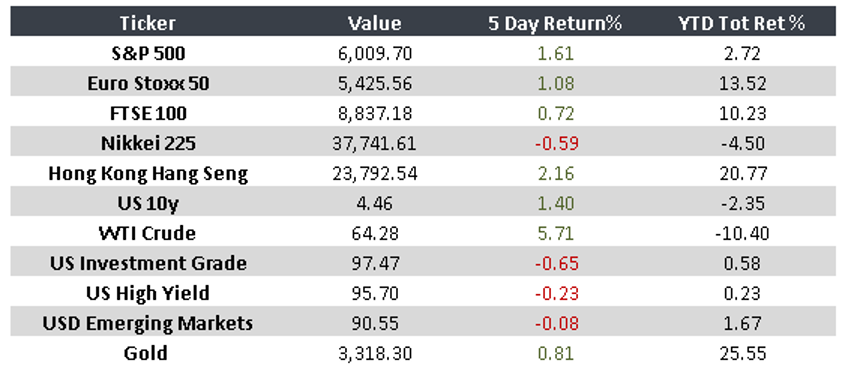
Mixed signals in the global economy: inflation, tariffs, and monetary policies shape the week

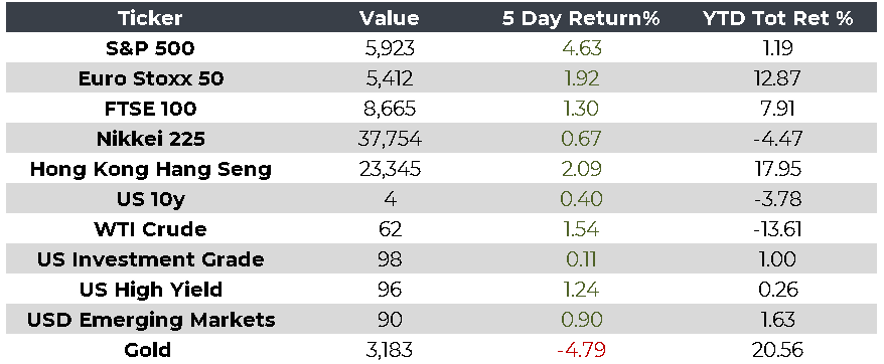
Volatile week for the markets, as tariffs and trade tensions once again captured investors’ attention. 


The economic environment continues to show mixed signals. While some indicators are improving, uncertainty remains around productive activity, inflation, and trade policies. Here are the most relevant data points from the week, by country: 

  • United States: The OECD cut its growth forecast to 1.6% for this year, impacted by tariffs. Job openings rose in April, while the services sector contracted for the first time in 12 months. 
  • Europe: Eurozone inflation dropped to 1.9%, below expectations. The ECB lowered its policy rate to 2%, and the services sector weakened, weighing on business activity. 
  • China: Manufacturing posted its sharpest contraction since 2022, hit by weaker external demand linked to tariffs. 
  • Brazil: The Central Bank reaffirmed its restrictive stance, while signaling flexibility to adjust monetary policy in light of new data. 
  • Mexico: Remittances fell 12.1% year-over-year in April. Still, the OECD raised its growth forecast, citing potential relief in trade tensions. 

“Don’t try to buy at the bottom and sell at the top. It can’t be done except by liars.” Bernard Baruch 

KEY UPCOMING EVENTS 

  • In China, export and inflation data will be released 06/08–09 
  • In the United States, May inflation data will be published 06/11 

Monitor 

Trade uncertainty: legal rulings and market outlook

Recent court decisions keep tariff policy in the spotlight. 

Tariff update: mixed signals from the courts 

In recent weeks, U.S. trade policy has returned to the spotlight. A ruling by the Court of International Trade suggested potential changes, but a federal appeals court has temporarily blocked that decision. As a result, current tariffs—covering sectors like steel, aluminum, and autos—remain in place. 

This ongoing legal tug-of-war is prolonging uncertainty for businesses and investors. Here’s a quick summary of the potential impacts: 

  • Economic impact: A hypothetical reduction in tariffs could lift GDP by 0.1% for every one percentage point drop in average rates, with a similar effect on inflation. But for now, it’s all still under negotiation. China has pushed back against the latest U.S. accusations. 
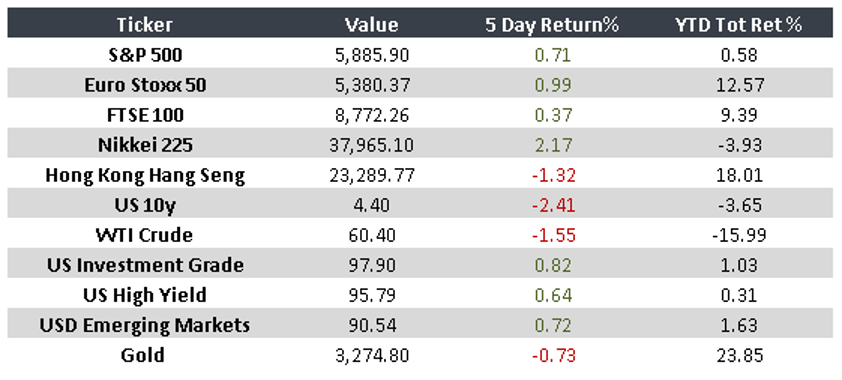
  • Market reaction: While the S&P 500 has shown signs of recovery, several headwinds remain—high valuations, 10-year Treasury yields hovering near 4.5%, fiscal uncertainty, and pressure on corporate margins. New tariffs could also emerge in sectors like semiconductors or pharmaceuticals. 

Market implications: 

Tariff policy remains uncertain — and likely to stay in focus. Until there’s more clarity, volatility may continue across markets. 

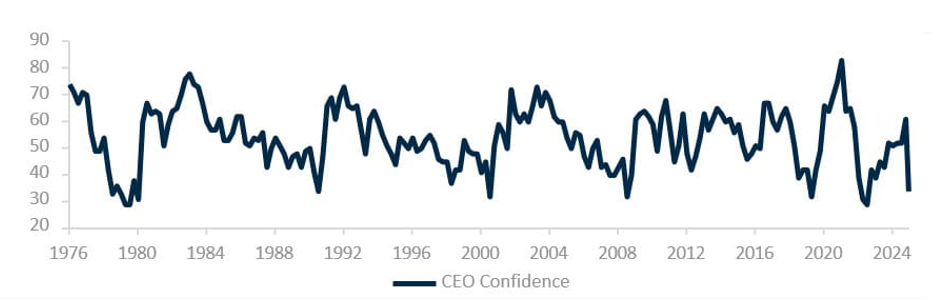
CEO confidence just saw its sharpest quarterly drop in nearly 50 years, driven in part by trade policy uncertainty. 

Source: Raymond James 

What’s Moving the Markets? Tariffs, Revisions, and Rate Cuts

It was a short week for the markets, with tariffs remaining the main focus.


Weekly Update: Mixed Signals and Key Decisions on the Radar 
Markets had a short trading week, but important developments still made waves. Here’s a regional breakdown of the most relevant news: 

  • United States: President Trump postponed the 50% tariffs on the European Union until July 9. Consumer confidence rebounded from multi-year lows, and Q1 2025 GDP showed a smaller-than-expected contraction of 0.2%. A trade court blocked global tariffs, but a federal appeals court temporarily reinstated them. 
  • Europe: Germany’s Chamber of Commerce projects a 0.3% economic contraction this year—marking three consecutive years of decline. The ECB is expected to cut rates by 25 bps in its upcoming policy announcement. 
  • China: Industrial profits rose 1.4% year over year in April, accelerating from the previous month. 
  • Brazil: May inflation fell to 5.4%, below market expectations. However, the average cost of domestic debt issuance climbed to 13.05%—the highest in over eight years. 
  • Mexico: The government confirmed that USMCA renegotiations will begin between September and October. The central bank lowered its 2025 growth forecast to 0.1% amid trade policy uncertainty. 

The global landscape remains shaped by a mix of encouraging data and ongoing risks. Attention will now shift to upcoming monetary policy decisions and ongoing trade negotiations.


KEY UPCOMING EVENTS 

  • U.S. ISM Manufacturing – June 1 
  • U.S. Employment Report – June 6 

Monitor 

 Sell in May and go away? 

A look at summer market prospects: Between strong historical trends and new risks on the horizon. 

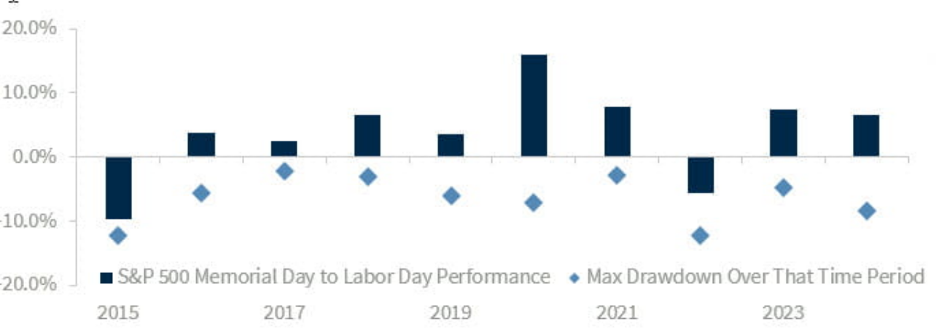
This old Wall Street saying tends to resurface around Memorial Day, suggesting investors reduce their exposure to stocks during a seasonally weaker period. But history doesn’t fully support that view. Over the past decade, the S&P 500 has averaged a +3.9% gain between Memorial Day (May 26) and Labor Day (September 1), closing higher 80% of the time. 

Still, summer isn’t without risks. Trade tensions, downward revisions to earnings estimates, and a recent rise in interest rates could weigh on investor sentiment. For example: 

  • Tariff effects may catch up: While the economy has shown resilience, growth is expected to slow in the second half of the year as tariffs begin to more noticeably impact consumer spending and business investment. 
  • Corporate earnings outlook: Q1 2025 surprised to the upside. However, many earnings reports still don’t fully reflect the new trade environment. Full-year EPS estimates have started to come down, though they remain relatively optimistic, projecting +10% annual growth. 
  • Rising long-term rates: With the 10-year Treasury yield now above 4.5%, valuation pressures are building – especially in interest-rate-sensitive sectors like real estate. 

Market implications: 

While history suggests summer can be a constructive period for markets, current conditions make it harder to rule out potential volatility. 

On average, the S&P 500 has seen a drawdown of roughly 7% at some point between May and September over the past decade. 

Source: Raymond James

Weekly Markets 

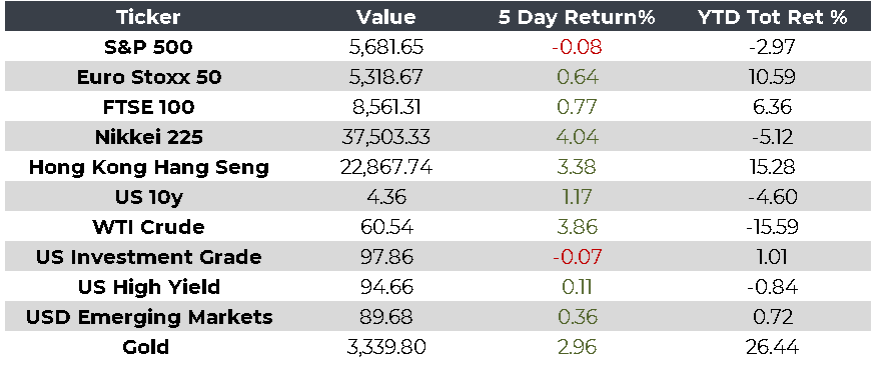
This week, markets were focused on the evolving fiscal debate and long-term interest rates. 

KEY HIGHLIGHTS BY REGION 

This week, Moody’s downgraded the U.S. sovereign credit rating from ‘Aaa’ to ‘Aa1’, citing the growing fiscal deficit and high refinancing costs. Meanwhile, the fiscal debate is intensifying, and the Fed remains cautious. Here are the main developments by region: 

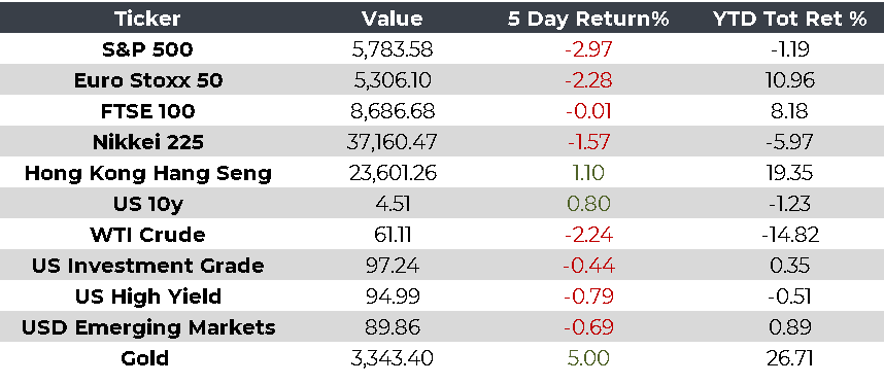
  • United States: Moody’s cut the U.S. credit rating. The House passed Trump’s fiscal plan, which includes tax cuts and increased defense spending. The Fed signaled no rate cuts before September. Yields on 10- and 30-year Treasuries rose. Toward the end of the week, President Trump proposed a 50% tariff on the European Union and a 25% tariff on Apple. 
  • Europe: U.K. inflation came in above expectations, reaching 3.5%. In Germany, the Ifo Business Climate Index rose more than forecast, signaling greater corporate confidence. 
  • China: Retail sales rose 5.1% year-over-year in April, missing expectations. The central bank cut its key lending rates for the first time since October. 
  • Brazil: Economic activity grew 0.8% in March, twice the expected pace. On a yearly basis, growth reached 3.49%. 
  • Mexico: Inflation in the first half of May accelerated to 4.22%. First-quarter GDP remained unchanged from the initial estimate. Additionally, a 15% average tariff is anticipated on vehicles exported to the U.S. 

Fiscal and trade uncertainty continues to shape the outlook. While many recent developments were partially priced in, upcoming shifts in interest rates, inflation, and growth will remain key drivers for markets in the months ahead. 


KEY DATES TO WATCH 

  • May 26 (U.S.): Markets closed for Memorial Day 
  • May 28 (U.S.): Release of the Fed’s latest meeting minutes 

Monitor

Evolving Global Economic Landscape 

This week, global economic activity delivered mixed signals. 

INTERNATIONAL OVERVIEW: MIXED SIGNALS FROM THE MARKETS 

Recent economic data reveal meaningful shifts in inflation, interest rates, and global activity. Here are the most relevant highlights by country: 

  • United States: A temporary tariff reduction was agreed upon with China. Inflation rose 0.2% in April, with an annual rate of 2.3%, coming in below expectations. Fed Chair Jerome Powell warned that interest rates may need to remain higher for longer due to supply chain pressures. 
  • Europe: Germany reported annual inflation of 2.2% in April, as expected. The U.K. economy surprised with 0.7% GDP growth in Q1, driven by strong business investment. 
  • China: Inflation turned negative again (-0.1% year-over-year), while producer prices dropped 2.7%. Analysts highlight the need for stronger fiscal stimulus to boost domestic consumption. 
  • Brazil: Around 30 agreements were signed with China across strategic sectors such as infrastructure, mining, artificial intelligence, and environmental initiatives. 
  • Mexico: The Bank of Mexico cut its benchmark rate to 8.5% for the third straight time and signaled the possibility of further easing. Consumer confidence continued to weaken. 

A long-term investor stays focused on strategies aligned with their risk tolerance to meet financial goals over time. 


KEY UPCOMING EVENTS 

  • China: Retail sales and industrial production data – May 19 
  • United States: Fed officials scheduled to speak – May 19–20 

Monitor 

Q1 2025 Results: Resilience and Early Signs of What’s Ahead

Q1 2025 ended on a strong note, despite ongoing challenges in the economic landscape.

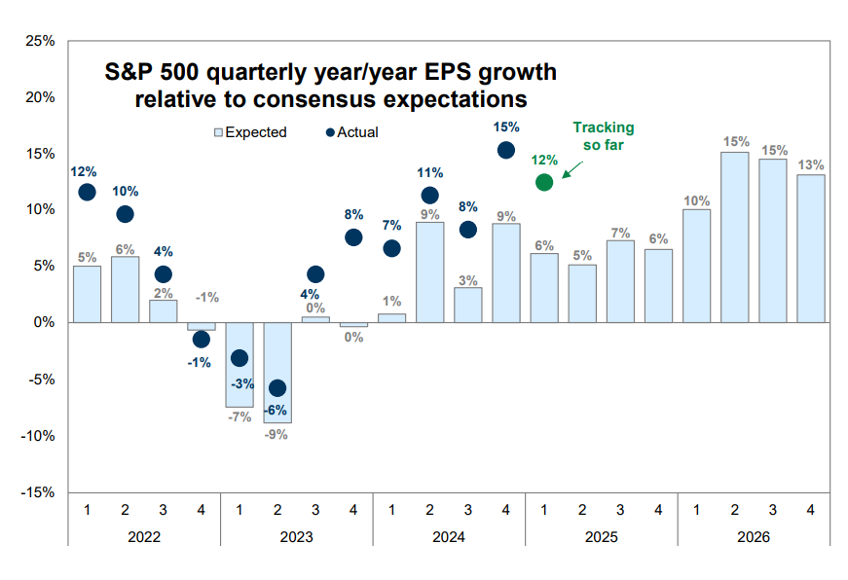
With nearly 85% of S&P 500 companies having reported, the first-quarter earnings season for 2025 showed encouraging strength. Earnings per share (EPS) grew 12% year over year, well above expectations. But corporate commentary also reflected a more cautious tone: mentions of terms like “tariffs” and “recession” rose sharply in investor calls. While consumer spending held up, some pressure is beginning to show in industries like restaurants, airlines, and premium retail. 
On the other hand, mega-cap tech companies stood out. Their earnings grew 29% year over year (vs. 9% for the rest of the S&P 493), driven by strong AI investments. Interestingly, their valuations relative to the broader index are now at their lowest since 2017. 

Market implications: 

Q1 2025 earnings helped support the S&P 500’s rebound in April, but they reflect past performance. Expectations for the rest of the year continue to trend lower and could be revised further as economic headwinds persist. 

Q1 2025 Earnings: Double-digit growth delivered. 

Source: Goldman Sachs. 

Central banks respond with caution

The Federal Reserve kept its benchmark interest rate unchanged at 4.25%–4.5%, as expected. However, the message was clear: uncertainty is rising. Jerome Powell warned that tariffs could lead to higher long-term inflation and slower economic growth. Meanwhile, President Trump announced a new trade deal with the U.K., though it does not currently include removing tariffs on China. 

Key international developments: 

  • Europe: Germany reported strong trade and industrial data for March. The Bank of England cut its interest rate to 4.25%.
     
  • China: New monetary stimulus measures were introduced, including a rate cut and a reduction in the bank reserve requirement ratio. 
  • Brazil: The Central Bank raised its benchmark rate to 14.75%—the highest level in two decades—and signaled that further hikes are possible. 
  • Mexico: April inflation came in at 3.93% year-over-year. Markets continue to expect another rate cut from Banxico, while growth forecasts are being revised downward. 

“Uncertainty actually is the friend of the buyer of long-term values” — Warren Buffett 


KEY UPCOMING EVENTS 

  • U.S. Inflation Report – May 13 
  • U.S. Retail Sales – May 15 

Monitor 

Fed Holds Rates, Flags Rising Uncertainty 

The Federal Reserve kept rates unchanged but struck a more cautious tone.  

A Pause Amid Uncertainty  


Job Market Stays Strong, But Economic Uncertainty Tempers Expectations for Quick Changes  


As expected by markets, the Federal Reserve kept its benchmark interest rate steady at 4.25%–4.5%, a level it has maintained since December. While the labor market remains solid, with 177,000 new jobs added in April, the Fed acknowledged growing economic challenges.  

Inflation remains high, and after the GDP contraction in Q1, the Fed’s statement highlighted a rise in economic uncertainty. The Fed stressed its commitment to monitoring risks that could impact its dual mandate: keeping inflation under control and supporting employment.  

According to Jerome Powell, weaker consumer and business outlooks are largely due to an uncertain trade environment.  

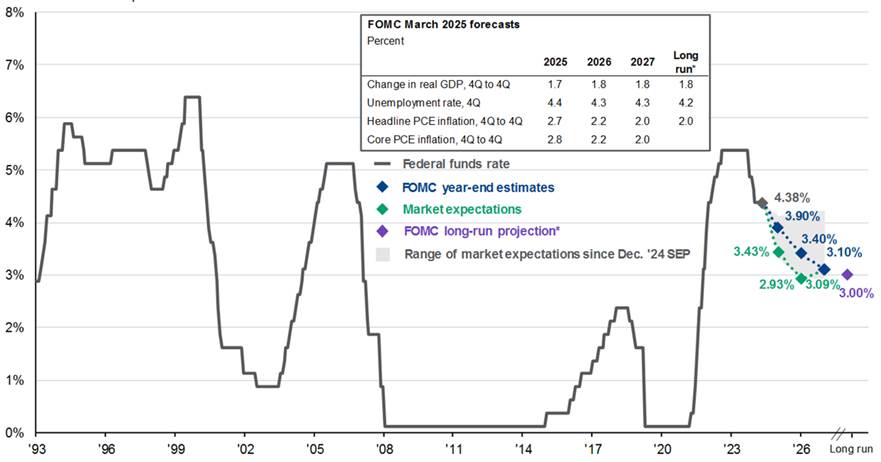
Looking ahead, the Fed reiterated that it’s prepared to adjust its policy stance if needed. Following the announcement, expectations for a rate cut in June dropped significantly.  


Market Implications  


The outlook remains uncertain. While the Fed held rates steady, the lower likelihood of immediate cuts highlights the importance of closely watching the economic and trade landscape.  

Fed Funds Rate Expectations  

Source: JP Morgan

Ponte en contacto con nosotros

Receive the best financial market news

Cookie Policy

We use our own and third party cookies to improve our services and show you advertising related to your preferences, by analyzing your browsing habits. By continuing, you confirm that you have read and accept this policy.