Uriel Loredo

Markets Between Resilience and Inflationary Pressure 

Week of June 8–12

Persistent inflation and geopolitical tensions continue to shape markets

The week was marked by higher inflation across several economies, energy-related pressures stemming from the Middle East conflict, and mixed growth signals. Despite these challenges, some sectors continue to demonstrate resilience, while investors remain focused on monetary policy decisions.

Inflation rose to 4.2%, while PPI reached its highest level since 2022. However, home sales remained strong, and SpaceX completed the largest IPO in history.

The ECB raised rates to 2.25% and revised its inflation outlook higher. Germany saw inflation moderate, while the UK recorded its first economic contraction since August.

GDP exceeded expectations, supported by consumer spending and exports. However, producer prices rose 6.3%, reflecting the impact of higher energy costs.

Inflation remained stable, but producer prices reached their highest level since 2022. Energy and commodity costs continue to pressure industrial margins.

Inflation edged up to 33.6% year-over-year in May. Despite the increase, it remains well below levels seen in recent years.

Inflation reached 4.72%, exceeding expectations and marking its highest level since September, driven by food and energy prices.

Inflation returned to Banxico’s target range and producer prices moderated. However, automotive production declined, although exports continued to grow.

“You make most of your money in a bear market, you just don’t realize it at the time.” — Shelby Cullom Davis

Key Upcoming Events

  • In the United States, industrial production data will be released 06/15
  • In the United States, the FED monetary policy decision will be released on 06/17

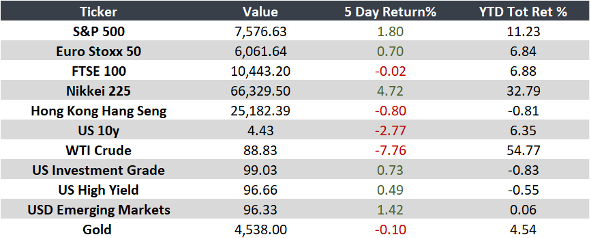
Monitor:

Note: Returns as of 10 AM ET.

Venture Capital

Behind many of the companies transforming industries lies an earlier financing stage known as Venture Capital, an asset class that bets on innovation before it reaches public markets.

An Introduction to a High-Growth Asset Class

Venture Capital is an asset class focused on financing innovative companies in the early stages of growth before they become publicly traded. Its objective is to capture the potential of businesses with disruptive models in sectors such as technology, artificial intelligence, healthcare, and software. While it involves higher risks than many other investment strategies, it also provides access to some of the most significant value-creation opportunities.

Throughout 2026, investor interest in the sector has remained strong, driven by the continued expansion of artificial intelligence and technological innovation. The appeal of Venture Capital lies in its ability to identify transformative trends before they reach public markets. Today, capital continues to flow toward established firms, while competition for investor commitments remains intense.

However, returns are often concentrated in a relatively small number of highly successful investments, making manager selection especially important. In this environment, experience, access to opportunities, and investment discipline are key drivers of consistent long-term performance.

Regions of Interest for Venture Capital Investors

Source: Preqin

Colombia Election 2026: Markets Focus on the Presidential Runoff

Colombia’s presidential election is headed to a runoff after a closer-than-expected first-round result. The outcome opens a new chapter for financial markets, which are now weighing the economic implications of each candidate more closely.

A Highly Competitive First Round Sets the Stage for June 21

Colombia’s presidential election is headed to a runoff after a closer-than-expected first-round result. Abelardo de la Espriella secured 43.7% of the vote, compared to Iván Cepeda’s 40.9%, highlighting a deeply polarized electorate and two distinct economic and political visions. Markets responded positively to the initial outcome, while investors begin to assess more closely how each candidate’s proposals could affect economic growth, private investment, fiscal stability, and long-term development.

The June 21 runoff will be closely watched by financial markets. De la Espriella has advocated for policies centered on strengthening private investment, fiscal discipline, public security, and closer economic ties with the United States. Meanwhile, Cepeda represents greater continuity with the current administration’s agenda, emphasizing social programs and a more active role for the state in the economy.

Regardless of the outcome, investors will focus on the next government’s ability to preserve fiscal stability and foster confidence for long-term investment. The June 21 election could become one of the most important political events in Latin America during 2026.

Source: Reuters

Global Weekly Overview

Markets remain resilient despite ongoing inflationary and geopolitical challenges

Markets ended the week on a more constructive note, supported by moderating oil prices and strong corporate earnings. However, inflation remains above central bank targets, while geopolitical tensions continue to shape the global economic outlook.

United States

Markets advanced, supported by lower oil prices and S&P 500 earnings growth of 28.4%, the strongest pace since 2021. Inflation remains elevated, while consumer confidence continues to face pressure.

Europe

The ECB remains cautious amid still-elevated inflation. Although consumer confidence improved, economic sentiment remains weak and core inflation continues to run above target.

Japan

Retail sales and employment exceeded expectations. Consumption remains resilient, supported by government stimulus measures and a strong labor market.

China

Industrial profits increased 24.7%, driven by technology, electronics, and energy, reflecting a more favorable recovery in strategic sectors.


Argentina

Inflation expectations continue to moderate. Authorities anticipate monthly inflation below April levels, easing concerns over exchange-rate pressures.

Brazil

GDP exceeded expectations, supported by investment and consumer spending. However, producer prices continue to reflect pressures stemming from the global energy environment.

Mexico

Banxico lowered its 2026 growth forecast. Nevertheless, exports and foreign direct investment reached record levels, supporting economic activity.

“Markets can remain irrational longer than you can remain solvent.” — John Maynard Keynes

KEY UPCOMING EVENTS

  • In the United States, manufacturing PMI will be released 06/01
  • In the United States, nonfarm payrolls will be released on 06/05

Monitor:

Note: Returns as of 10 AM ET.

Earnings

The S&P 500 posts its strongest earnings growth since 2021.

Corporate results continue to surprise positively

The Q1 2026 earnings season has delivered strong results for the S&P 500. With 94% of companies having reported, 84% exceeded earnings expectations and 81% beat revenue estimates. Annual earnings growth stands at 28.4%, the highest since 2021, while revenues are up 11.6%.

Consensus expectations point to earnings growth of approximately 22% for full-year 2026, supporting market optimism despite elevated valuations. The S&P 500 forward P/E stands at 21.1x, above historical averages.

Corporate performance continues to be one of the main supports for the U.S. market. Positive earnings revisions reflect companies’ operational resilience and adaptability. However, elevated valuations suggest that part of the optimism is already priced in, which could increase market sensitivity if expectations are not met.

Monitor

Source: FactSet

Global Weekly Overview 

A week marked by inflation pressures, rising rates, and mixed growth signals

Markets are facing a more restrictive environment, with persistent inflationary pressures and rising interest rates. While some economies show resilience, others reflect a slowdown, amid ongoing geopolitical risks.

United States

  • Fed Minutes point to potential rate hikes.
  • 30-year yields surpass 5%.
  • Earnings grow ~28%, but housing weakens.
  • Labor market remains resilient.

Europe

  • Eurozone inflation rises to 3.0% driven by energy.
  • UK inflation moderates, but unemployment increases.
  • Germany grows in line with expectations, with rising cost pressures.

Japan

  • GDP exceeds expectations, but energy costs threaten growth.
  • Inflation falls to 1.4%, remaining below the central bank’s target.

China

  • Retail sales and industrial production slow.
  • Weak domestic demand reflects softer consumption and manufacturing momentum.

Argentina

  • Economic activity rebounds to 5.5%, reversing the previous contraction and signaling recovery.

Brazil

  • Economic activity declines monthly but maintains 3.1% annual growth, reflecting partial resilience.

Mexico

  • Moody’s downgrades rating to Baa3.
  • Growth remains moderate, supported by services and easing inflation.

“Be fearful when others are greedy. Be greedy when others are fearful.” — Warren Buffett

KEY UPCOMING EVENTS

  • In the United States, markets will remain closed for Memorial Day 05/25
  • In the United States, employment related data will be released 05/27

Monitor:

Note: Returns as of 10 AM ET.
Source: JP Morgan

Real Estate

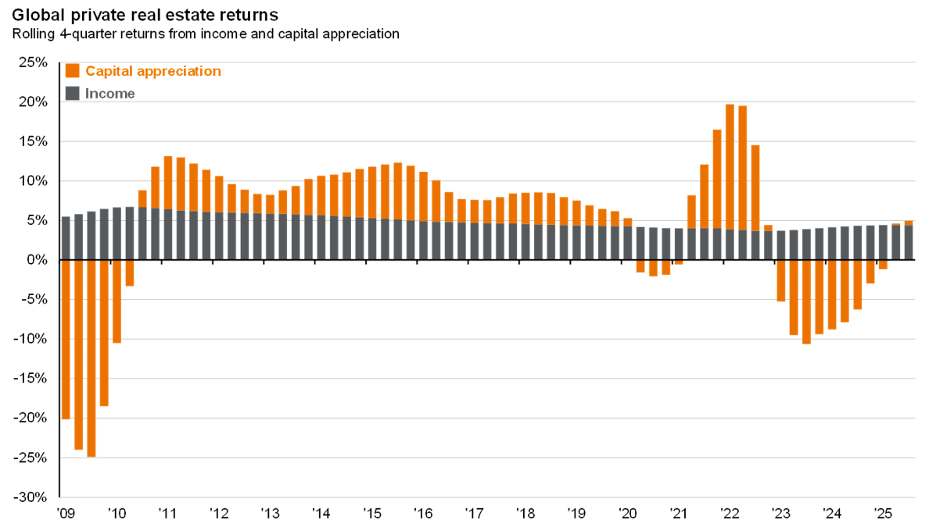
Real estate remains a key building block of diversified portfolios. Understanding its fundamentals is essential to evaluating its role as an income generator and inflation hedge.

A core asset class: fundamentals and key trends

Real estate is an asset class based on investing in physical properties — such as residential, office, and logistics infrastructure — that generate income through rents and capital appreciation. Its appeal lies in its ability to produce relatively stable cash flows and act as a partial hedge against inflation, making it a relevant component of diversified portfolios.

In 2025, fundraising has rebounded, driven primarily by debt strategies and opportunistic funds. North America leads global activity, while Europe and Asia show more limited momentum. Despite this recovery, the current environment presents challenges: lower transaction activity, valuation pressures, and increased selectivity in capital allocation.

For investors, the current moment calls for discipline and clarity around risk-return objectives. Demographic trends and structural housing shortages continue to create opportunities, while the growing relevance of debt strategies and residential assets reflects a repositioning in market preferences.

Monitor

Source: JP Morgan

Global Weekly Overview


A week marked by elevated inflation and mixed growth signals


Recent data point to a backdrop of persistent inflation driven by energy and geopolitical tensions. Despite this, consumption remains resilient in some economies, while growth is losing momentum in others.

United States
Inflation rises to 3.8% and PPI to 6.0%, driven by energy. Consumption remains resilient, but housing is slowing. Markets scale back rate cut expectations and increase the probability of hikes.

Europe
Eurozone GDP grows 0.8%, impacted by energy. Germany faces rising inflation and costs, while the UK surprises with stronger growth, although investment remains weak.

Japan
Producer prices rise to 4.9%, the highest since 2023. Energy costs are increasing inflationary pressures and influencing BoJ policy.

China
Inflation rises to 1.2% and PPI to 2.8%, driven by energy. Cost pressures could pass through to global prices despite weak food demand.

Argentina
Inflation slows to 32.4% year-over-year. While still elevated, it shows a moderating trend compared to previous levels.

Brazil
Inflation rises to 4.39%, driven by food and transportation. The figure remains below expectations, reflecting contained pressures.

Mexico
Employment grows but remains below required levels. Industrial activity contracts, while the automotive sector stands out as a key driver due to export strength.

“Patience is not passive; it is concentrated strength.” – Bruce Lee

KEY UPCOMING EVENTS

  • In the United States, the FED minutes will be released on 05/20
  • In the United States, employment related data will be released on 05/21

Monitor:

Note: Returns as of 10 AM ET.

Global Outlook

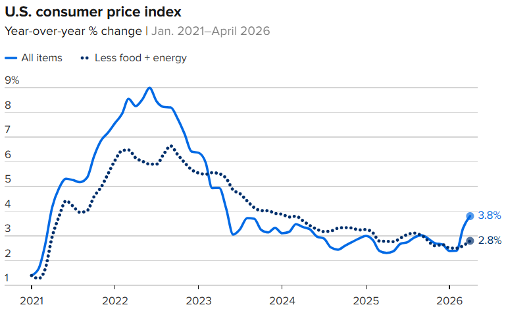
April’s inflation data in the U.S. presents a mixed picture: rising prices alongside a consumer that, for now, is holding firm.

U.S. inflation reaches highs while retail holds steady

U.S. inflation accelerated to 3.8% year-over-year in April, its highest level since May 2023. While the energy sector drove much of the increase, core inflation also rose to 2.8%, remaining above the Federal Reserve’s target.

Despite this environment and a slight decline in real wages, consumer spending remains notably resilient. The retail sector added 22,000 jobs during the month, reflecting strong business confidence amid sustained demand.

Persistent inflation complicates the Federal Reserve’s outlook. However, labor market resilience and continued hiring in retail suggest that consumption is, for now, cushioning the impact of higher fuel costs and geopolitical tensions.

Source: Bureau of Labor Statistics

Global Weekly Overview

A week marked by inflation pressures and slowing activity

Recent data point to a moderate growth environment with persistent cost pressures. Inflation driven by energy and geopolitical tensions continues to shape monetary policy decisions globally.

  • Strong earnings (83% beating estimates) drive profit growth to ~23%.
  • Employment exceeds expectations but is slowing.
  • PMI signals rising cost pressures that could pass through to inflation.

  • Industrial costs remain elevated and services PMI drops to a 62-month low.
  • In Germany, weakness in manufacturing and services increases recession risks.

  • Services activity slows, while central bank minutes suggest potential rate hikes.
  • Energy shocks are raising inflation risks and pressure on exports.

  • Composite PMI improves on stronger demand, but input costs reach their highest levels since 2022, pressuring margins and growth sustainability.

  • Industrial activity rises 5.0% year-over-year, driven by chemicals. However, sectors such as machinery and textiles remain in contraction.

  • Industrial production rebounds 4.3%, reflecting the positive impact of rate cuts despite a more challenging global environment.

  • Banxico cuts rates to 6.50% and inflation slows.
  • Investment falls 4.2%, signaling weaker momentum and pressure on future growth.

“Time is your friend, impulse is your enemy.” — John Bogle

KEY UPCOMING EVENTS

  • In the United States, Inflation data will be released — 05/12
  • In the United States, PPI data will be released — 05/13

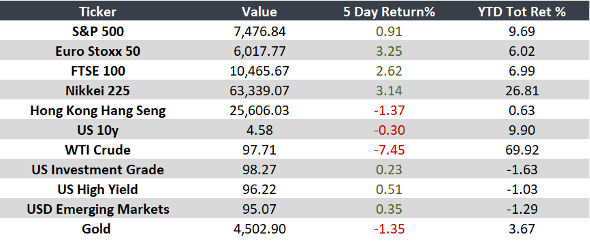
Monitor:

Note: Returns as of 10 AM ET.
Ponte en contacto con nosotros

Receive the best financial market news

Cookie Policy

We use our own and third party cookies to improve our services and show you advertising related to your preferences, by analyzing your browsing habits. By continuing, you confirm that you have read and accept this policy.